

“But as for me and my house, we will serve the Lord.” — Joshua 24:15 (ESV)
Families don’t always look like picture-perfect portraits. Sometimes they come with stories of heartbreak, restoration, new beginnings—and grace woven through every chapter.
That’s the story of my family. A blended family.
My oldest daughter is my stepdaughter—whom I’ve had the joy of loving and raising as my own over half her life. My son came from my first marriage—a season marked by both growth and pain. And my youngest daughter was born into the covenant of my current marriage, the fruit of healing and God’s faithfulness.
I know the complexities of trying to build unity when everyone didn’t start in the same place. I’ve wrestled with guilt, navigated identity tensions, and clung to God in seasons when love wasn’t always returned the way I hoped. But I’ve also seen grace—grace that shows up in late-night talks, in second chances, and in the way God uses even the hardest parts of our stories to build something sacred.
If you’re a stepparent, a co-parent, or a parent in a blended family, I want to encourage you: God sees you. He’s not waiting for your family to look “perfect” before He uses you. He’s shaping a legacy right where you are, in your family.
Defining your place as a stepparent can be difficult. You’re not trying to replace anyone—but you’re also not a stranger. You’re shaping a soul, planting seeds of faith and love, even when the soil is hard.
In Scripture, we find a powerful, often overlooked example in Joseph, the earthly father of Jesus. Joseph wasn’t Jesus’ biological father—but he loved Him, protected Him, and raised Him with integrity and faith.
Joseph’s Story: A Legacy Built in Obscurity
Joseph lived in the shadows of Roman occupation and Herodian tyranny—an ordinary man in an extraordinary time. The land of Judea was politically tense, spiritually hungry, and socially fragile. Herod the Great ruled with paranoia and violence, and Rome’s grip left most Jewish families living under economic strain and national unrest.
Joseph wasn’t a rabbi, a scribe, or a revolutionary. He held no religious title, made no public speeches, and left behind no written words in Scripture. He was a humble tekton—a craftsman by trade. Likely skilled in stone and wood, he worked with his hands, perhaps commuting to nearby cities like Sepphoris to earn enough to care for his family. He was a man of modest means, evidenced by the offering of two doves at Jesus’ dedication in the temple—a provision reserved for the poor.
And yet God entrusted him with the care of the Messiah.
Not as a biological father—but as the one who would protect Him, guide Him, teach Him, and give Him a name. Joseph stood in the gap, embracing a role he never sought, accepting a call that would upend his life, and trusting a promise that defied human understanding.
In the eyes of the world, Joseph was a nobody. But in the eyes of heaven, he was exactly the man for the moment.
God didn’t choose Joseph for fame.
He chose him for faithfulness.
And in doing so, Joseph built a legacy—not on a platform, but in the obscurity of obedience.
A Righteous Man in a Messy Situation
Joseph was betrothed to Mary—a covenantal promise considered as binding as marriage itself in first-century Jewish culture. This wasn’t a casual engagement. Breaking it required a legal divorce, and any sexual infidelity during this period was considered adultery under the Mosaic Law. So when Joseph discovered Mary was pregnant—and he knew he wasn’t the father—his world must have felt like it shattered beneath him.
He had every legal and cultural reason to expose her. Doing so would have preserved his own honor and distanced him from public scandal. But Scripture gives us a glimpse into the depth of his character:
“Joseph, being a just man and unwilling to put her to shame, resolved to divorce her quietly.” — Matthew 1:19 (ESV)
Joseph’s righteousness wasn’t cold or condemning—it was wrapped in compassion. He honored the Law, but his instinct was to protect Mary’s dignity, even in what appeared to be betrayal. He chose mercy over public vindication.
Then God intervened.
“Joseph, son of David, do not fear to take Mary as your wife, for that which is conceived in her is from the Holy Spirit.” — Matthew 1:20 (ESV)
This divine message was a turning point. Joseph was called not only to believe the impossible, but to stake his entire reputation and future on it. Obedience meant embracing apparent scandal. Faith meant stepping into uncertainty.
But Joseph chose God’s voice over public opinion. He took Mary as his wife. He named the child Jesus—an act that, in Jewish tradition, conferred legal paternity and affirmed Jesus’ rightful place in the Davidic line. In doing so, Joseph not only aligned himself with God’s redemptive plan, but became an active participant in it.
And that quiet act of obedience would change the world.
Quiet Obedience, Lasting Impact
Joseph never speaks in the pages of Scripture. We have no recorded words—no psalms, no prayers, no teachings—only his actions. And yet, those silent decisions ripple through eternity.
He leads Mary and Jesus through immense political danger, faithfully responding to divine direction: fleeing to Egypt under the threat of Herod’s wrath, then returning to settle in Nazareth. Each move was strategic, fulfilling prophecy, and rooted in trust.
He raised the Son of God in humble surroundings, likely teaching Him Torah, traditions, and trade. Jesus would grow not in palace luxury but in a carpenter’s home—surrounded by the steady rhythms of work, prayer, and obedience.
And Joseph did all of it without seeking attention or acclaim. He simply did what needed to be done. He loved Jesus not by blood, but by choice. Not for status, but out of surrender.
His example is a blueprint for every stepparent, adoptive parent, or caregiver who has chosen to stand in the gap—to love, lead, and lift up a child not born of them, but entrusted to them.
Joseph shows us that legacy isn’t built by volume—but by virtue. It’s shaped not by the platform, but in the hidden places where faith is forged and love is lived.
And this brings us to where it matters most: how we live that legacy in our own families today.
My Story: Fathering in the Middle of Complexity
Joseph’s story hits close to home.
He wasn’t asked to raise the Messiah because of prestige or position—but because of his willingness to say “yes” to a difficult assignment. He stepped into fatherhood through surrender, not strategy. He chose love in a situation that others would have walked away from.
And in many ways, that reflects my own journey in fatherhood.
My family didn’t begin with a perfect script. It’s a story of grace in layers.
My oldest daughter is my stepdaughter. I wasn’t there for her first steps or her early milestones, but I’ve had the privilege of walking with her through critical seasons of growth, identity, and faith. I’ve learned that loving a child as your own isn’t about replacing the past—it’s about building something redemptive in the present.
My son is from my first marriage. That season of life carried its own set of joys and challenges, some of which I never expected to walk through. Co-parenting in the aftermath of divorce requires humility, patience, and a commitment to rise above bitterness for the sake of your child’s heart.
My youngest daughter is from my current marriage—a beautiful reminder of God’s ability to redeem what once felt broken and create new beginnings that overflow with hope.
Our family is a mosaic. Each piece comes from a different place, shaped by different seasons—but by God’s hand, they’re held together with love.
Like I imagine Joseph did, I’ve had moments where I questioned my place. Times when I wondered if I was enough. Moments where love wasn’t returned the way I had hoped, or where old wounds complicated new efforts.
But God has been faithful.
Through late-night conversations, prayerful silence, shared laughter, and even difficult discipline—He’s reminded me that fatherhood isn’t about perfection—it’s about presence. It’s not defined by DNA, but by devotion. And the most lasting legacy I can leave my children—whether biological or not—is a life marked by obedience to God and sacrificial love for them.
Just like Joseph, I don’t need to be remembered for what I say. I just want my children to remember how I lived: with consistency, integrity, and a heart surrendered to Jesus.
Living and Leading Like Joseph in a Blended Family
Joseph didn’t ask for the role he was given—but he stepped into it with courage, compassion, and quiet obedience. His example is more than inspirational; it’s instructional for anyone navigating the complexities of a blended family.
Here are three key lessons from Joseph’s life that every stepparent or blended-family parent can apply today:
1. Faithfulness Precedes the Title—But the Title Still Matters
Joseph was not Jesus’ biological father, yet he was entrusted with the role of raising the Son of God. He obeyed God. He protected Jesus. He taught Him, provided for Him, and loved Him with a father’s heart. And though Scripture doesn’t record Jesus calling Joseph “Dad,” the culture would have affirmed his role as such—and so does heaven.
“He called His name Jesus.” — Matthew 1:25
For many stepparents, there’s a quiet ache beneath the surface: Will they ever call me Dad? Will they ever see me as more than just the one who married their mom?
Let’s be honest—titles matter. Not because they define your worth, but because they often reflect a growing bond of trust, love, and belonging. Being called “Dad” or “Mom” may not happen overnight—or at all in some cases—but it’s not wrong to long for it. In fact, it speaks to the love you’ve chosen to give.
Still, Joseph reminds us: you don’t wait for the title to prove your faithfulness—you live faithfully whether the title comes or not. His identity as Jesus’ father was secured not by biology, but by love-in-action. And over time, love-in-action builds something stronger than titles alone ever could: it builds legacy.
Legacy isn’t born in a single moment of recognition—it’s forged in the long obedience of everyday presence. It’s in the school pickups, the midnight prayers, the grace you offer when you’re misunderstood, and the discipline you hold with gentleness. It’s in the thousand unseen sacrifices that say, “I’m here. I’m not leaving. I’m all in.”
Joseph’s life gives us permission to grieve what may not be spoken, while still stepping fully into the sacred role we’ve been given. You may not have heard “Dad” yet, but that doesn’t mean you aren’t one. Heaven sees you that way. And often, in time, the hearts of your children catch up to what your actions have been saying all along.
So don’t pull back. Don’t let the lack of a title make you question your impact. Keep investing. Keep loving. Keep showing up. Because fatherhood isn’t ultimately about the name they call you—it’s about the legacy you leave behind in the life they live.
And that’s where Joseph’s quiet example leads us next: into a life of obedience that outlives the moment.
2. Choose Obedience Over Emotion—Even When It’s Hard
When Joseph discovered Mary was pregnant, his emotional world must have been turned upside down. The sense of betrayal, confusion, heartbreak, and shame would have been overwhelming. In his mind, the woman he loved and had pledged himself to had seemingly been unfaithful. His plans, his reputation, and his future all appeared to be unraveling.
And yet, even in that emotional storm, Scripture tells us Joseph was a just man—committed to honoring both the law and Mary’s dignity. He resolved to divorce her quietly. That choice in itself was an act of mercy.
But then God spoke.
“Joseph, son of David, do not fear to take Mary as your wife, for that which is conceived in her is from the Holy Spirit.” — Matthew 1:20 (ESV)
God didn’t explain everything. He didn’t lay out how the people of Nazareth would respond. He simply gave a command—and Joseph obeyed.
“When Joseph woke from sleep, he did as the angel of the Lord commanded him.”
— Matthew 1:24
No hesitation. No debate. Just trust.
That kind of obedience is costly—especially when your emotions haven’t caught up yet. And that’s where so many blended family dynamics get tested. You may feel misunderstood, excluded, or unappreciated. You might carry wounds from the past or tensions with a co-parent. There are days when emotions rise high—and you’re tempted to withdraw, lash out, or just go through the motions.
But Joseph teaches us that obedience to God must lead us—even when our emotions don’t.
You may not feel like stepping into that hard conversation with gentleness.
You may not feel like extending grace again.
You may not feel like investing when affection isn’t reciprocated.
But obedience says: I’m going to do what’s right, not what’s easiest.
It says: I’ll love like Christ, even when it hurts.
Obedience isn’t blind or robotic. It’s rooted in trusting that God is working something greater in and through you—even if you can’t see it yet.
In a blended family, your consistent obedience becomes an anchor for your home. It communicates stability in the midst of unpredictability. It builds trust over time, even when relationships feel fragile. And it teaches your children—by example—that obedience to God is always worth it, even when it’s not immediately rewarding.
So when emotions rise and patience wears thin, take a breath, pray for strength, and ask:
What does obedience look like in this moment?
Because the way you respond—especially when it’s hard—is what shapes the spiritual tone of your home.
And your home, like Joseph’s, can be the very place where God’s redemptive plan quietly unfolds.
3. Legacy Is Forged in the Ordinary Moments
Joseph doesn’t get much spotlight in Scripture. He’s not quoted. He doesn’t perform miracles or preach sermons. His story is quiet, his role behind the scenes. But his impact is profound—not because of grand gestures, but because of consistent, unseen faithfulness.
He listened when God spoke.
He went where God led.
He showed up, day after day, to raise the Son of God—not with applause, but with integrity.
His legacy wasn’t forged in a single dramatic moment. It was shaped in the countless ordinary moments: walking to synagogue, teaching Jesus how to hold a chisel, sitting at the dinner table after a long day of work. The divine plan unfolded in a humble carpenter’s home, through the daily rhythm of obedience, provision, and presence.
And the same is true for you.
As a stepparent—or any parent in a blended family—you may not get public praise. You may feel like your efforts go unnoticed, your sacrifices unthanked, and your presence underappreciated. You might quietly carry emotional weight that others don’t see: balancing boundaries, bridging relationships, and trying to build unity where there’s been division.
But let me assure you: God sees what no one else does.
“Your Father who sees in secret will reward you.” — Matthew 6:4 (ESV)
He sees you choosing love when you’re tired.
He sees you praying when the tension is high.
He sees you investing in a child’s heart even when the connection feels fragile.
The bedtime prayers, the car rides, the game nights, the forgiveness you offer after hard conversations—these are the building blocks of legacy. Not flashy. Not headline-worthy. But deeply Christlike.
Your greatest impact may not be in what you say, but in how you live—faithfully, consistently, and humbly. Like Joseph, you’re helping shape a life that will impact generations. Your children may not understand the weight of what you’re doing right now—but one day, they will. And when they do, they’ll remember the quiet strength, the steadfast presence, and the sacrificial love that shaped their home.
So don’t despise the ordinary. Lean into it. That’s where legacy is born.
Legacy Is Not Perfect—It’s Faithful
Joseph’s life may not fill many pages in the Bible, but the legacy he left echoes through all of Scripture. He didn’t get to see the cross, the resurrection, or the spread of the Gospel. But he played an irreplaceable part in preparing the One who would bring it all to pass.
And so do you.
Parenting in a blended family isn’t easy. It’s sacred, but often complex. There will be moments when your role feels unclear, when your love feels unnoticed, when your patience feels thin. But take heart—God does some of His most powerful work through people who simply stay faithful in the unseen.
Whether you’re waiting to be called “Dad,” wrestling with the emotional weight of divided loyalties, or wondering if your efforts are making a difference—know this:
- Your presence matters.
- Your obedience matters.
- Your love—especially when it’s chosen, not required—matters.
God didn’t choose Joseph because of a platform. He chose him because of his posture—humble, available, obedient. And through his quiet faithfulness, Joseph helped raise the Savior of the world.
You may not be raising the Messiah—but you are raising someone made in His image. Someone who will carry your words, your example, and your love far beyond your home. That’s legacy.
So keep showing up. Keep doing the unseen, ordinary things.
Keep choosing obedience over emotion, and faithfulness even when the title isn’t spoken.
Because in the hands of God, those ordinary moments become eternal seeds.
You’re not just blending a family. You’re building a legacy.

What if the most powerful leadership decision you make today doesn’t happen in front of a crowd—but in the quiet of your prayer closet?
We live in a world addicted to activity and affirmation. Influence is often measured by how many followers you have, how strategic your moves are, or how loud your voice is. Leadership, we’re told, is about platform, polish, and productivity.
But Paul sees something different.
In his letter to Timothy—a young pastor learning to lead in the chaos of culture—Paul doesn’t start with policies or programs. He doesn’t tell Timothy to host a leadership conference or upgrade his preaching style. Instead, Paul’s first instruction is simple, yet foundational:
“First of all, then, I urge that supplications, prayers, intercessions, and thanksgivings be made for all people…”
— 1 Timothy 2:1 (ESV)
First of all.
Not eventually. Not when things get out of hand. Not after you’ve tried everything else.
Prayer is not a side dish to leadership—it’s the starting point.
Before you stand before people, you must kneel before God. Before you cast vision, you must carry people in prayer. Real leadership, Paul insists, is birthed not on stages, but in surrendered intercession. And if you miss this, you’ll lead in your own strength—and eventually run out of it.
How would it look to lead like Paul urges Timothy—to lead from your knees? To make prayer not your backup plan, but your battle plan?
Let’s dive into 1 Timothy 2:1–8 and discover how prayer that shapes a generation begins with a leader who’s first shaped by the presence of God.
A Call to All-In Intercession
Paul isn’t just giving Timothy a general encouragement to pray—he’s calling him into a life-shaping rhythm of all-in intercession. The language he uses in 1 Timothy 2:1 is intentional and layered. Each word—supplications, prayers, intercessions, and thanksgivings—unfolds a different aspect of the kind of prayer that doesn’t just influence a moment, but helps shape a movement.
Let’s break it down:
- Supplications are personal cries for specific needs. This is the raw, humble posture of a heart that knows it’s dependent. It’s the leader who says, “God, I don’t have what it takes without You.” In supplication, we bring our desperation to the One who is never in shortage.
- Prayers is a more general word, but it carries the idea of ongoing connection and worshipful communion with God. It’s not just asking—it’s abiding. These are the quiet moments of spiritual intimacy that form the foundation of public leadership. A praying leader is a grounded leader.
- Intercessions point to advocacy—standing in the gap for others. This is where leadership shifts from being about you to being for others. When you intercede, you carry someone else’s burden to the feet of Jesus. You plead not for your own comfort, but for someone else’s breakthrough.
- Thanksgivings may seem out of place in a list full of deep spiritual groaning—but they’re actually essential. Gratitude changes the atmosphere. It lifts our perspective from the problem to the Provider. It reminds us that God has been faithful before, and He’ll be faithful again.
Together, these four expressions create a picture of robust, holistic prayer. Not rushed. Not mechanical. Not religious performance. This is the lifeblood of spiritual leadership.
But Paul doesn’t stop at how to pray—he challenges who to pray for.
“…for all people, for kings and all who are in high positions…”
— 1 Timothy 2:1–2 (ESV)
This is where it gets uncomfortable for a lot of us.
Paul’s command isn’t limited to those we like, agree with, or voted for. It’s expansive. Inclusive. Countercultural. He’s calling the church—and especially its leaders—to pray for everyone, including the powerful, the problematic, and even the persecutors.
In a polarized world where it’s easier to throw stones than offer prayers, Paul reminds Timothy—and us—that spiritual authority doesn’t come from who you can out-argue, but who you’re willing to kneel for.
This kind of intercession is spiritual warfare. It disrupts darkness. It softens hardened hearts. It shapes culture not through control, but through communion with the King of kings.
Because here’s the truth: When you kneel in prayer for others, especially those in authority, you’re no longer leading just with human influence—you’re leading with heaven’s authority.
This is what makes prayer more than a discipline—it makes it a declaration. A declaration that says, “God, I trust You more than the systems around me. I believe You’re still sovereign over the chaos. And I will lead—not from reaction, but from reverence.”
The Goal of Godly Peace
Why does Paul begin his charge to Timothy with such a bold emphasis on prayer? Because at its core, prayer isn’t just a spiritual exercise—it’s a leadership strategy rooted in eternal purpose.
“…that we may lead a peaceful and quiet life, godly and dignified in every way.”
— 1 Timothy 2:2 (ESV)
Let’s be clear—Paul is not promoting a cozy, conflict-free Christianity. He’s not suggesting we trade boldness for comfort or water down the Gospel to keep the peace. Instead, he’s pointing to a kind of peace that positions the church for impact.
The words peaceful and quiet speak to a life marked by spiritual steadiness and external credibility. When leaders are grounded in prayer, they’re less reactive and more rooted. They bring calm into chaos. They’re not driven by noise—they carry a presence of peace that flows from time spent in God’s.
And look at the fruit: godly and dignified in every way.
- Godliness is our posture before God—a life shaped by worship, surrender, and holy dependence.
- Dignity is how we carry ourselves before others—with integrity, honor, and a humility that compels respect.
Together, these are the marks of a leader who doesn’t just speak the Gospel—they embody it.
But Paul doesn’t stop with the personal impact of prayer—he lifts our vision higher. This peaceful, gospel-shaped life isn’t just for our benefit. It clears the path for something far greater:
“This is good, and it is pleasing in the sight of God our Savior,
who desires all people to be saved and to come to the knowledge of the truth.”
— 1 Timothy 2:3–4 (ESV)
This is where it all comes together.
The goal of godly peace isn’t passivity—it’s proclamation. When we pray, when we lead lives of godliness and dignity, we cultivate an environment where the Gospel can take root. We remove barriers. We reflect the heart of the One who desires all people to be saved.
Our intercession becomes participation in God’s mission. We aren’t just praying for protection—we’re praying for salvation. We’re not just praying for leaders to make wise decisions—we’re praying for lost hearts to be awakened by truth. Prayer becomes the launchpad for revival.
So let’s reframe our leadership lens:
Prayer is not a pause in the action—it is the action.
It doesn’t slow the mission down—it sustains it and accelerates it.
It doesn’t just shape our circumstances—it shapes us into the kind of people God can use.
That means your prayer life isn’t just a private ritual—it’s a public responsibility. It’s the hidden engine of gospel influence. It’s how we align our leadership with God’s heart and heaven’s agenda.
Because when the people of God pray, the peace of God flows—and that peace makes room for the power of God to move.
Men, Lead by Lifting Hands
Paul ends this section with a striking and specific call to action:
“I desire then that in every place the men should pray, lifting holy hands without anger or quarreling.”
— 1 Timothy 2:8 (ESV)
In a letter packed with leadership instruction, this verse lands like a spotlight aimed directly at the hearts of the men in the church. Paul is calling them—calling us—to lead spiritually, not with volume or dominance, but with surrendered prayer and holy posture.
This wasn’t a gentle suggestion. It was a necessary correction.
In Paul’s day—as in ours—it was far too common for men to disengage spiritually, to lean into arguments rather than intercession, to stir division rather than unity. But Paul calls for something radically different: a new kind of male leadership, marked not by clenched fists but by lifted hands.
The imagery here is powerful. In Scripture, lifted hands are a symbol of surrender, of worship, of open-hearted dependence on God. Paul isn’t just describing a physical posture—he’s calling for a spiritual disposition.
- Lifted hands say, “I’m not in control—God is.”
- Holy hands speak to purity in motive and lifestyle. Leadership without holiness is hollow.
- Without anger or quarreling reminds us that spiritual authority flows from peace, not pride.
This is a call for men to model maturity. To be the first to forgive. The first to repent. The first to step into prayer when tensions rise. To lead not from ego, but from the presence of God.
This isn’t about being passive—it’s about being powerful in the Spirit. Men who pray set the spiritual tone in their homes, churches, and communities. They create space for others to flourish under the covering of intercession.
If You Want to Lead, Learn to Kneel
Leadership rooted in prayer is not just a private discipline—it’s a public witness. When Paul instructs Timothy to make intercession a priority, he’s laying the foundation for a life of influence that begins in the presence of God. This isn’t a call to passive spirituality—it’s a challenge to lead with spiritual authority that only comes through intimacy with the Father.
Let’s look at three biblical keys to leadership through prayer—anchored in 1 Timothy 2:1–8 and echoed throughout Scripture:
1. Start with Surrender
“First of all, then, I urge that supplications, prayers, intercessions, and thanksgivings be made…”
— 1 Timothy 2:1 (ESV)
As we pointed out earlier, Paul doesn’t begin his leadership instructions with structure or strategy. He begins with surrender. Before anything else, he urges Timothy to prioritize prayer—not as a spiritual accessory, but as the foundation of faithful leadership. “First of all” isn’t a casual phrase—it’s a declaration of alignment. Prayer isn’t something we work in when there’s time; it’s the first move of a leader who walks with God.
This kind of prayer is multi-dimensional: it includes supplication—bringing our needs in humility, intercession—standing in the gap for others, and thanksgiving—acknowledging God’s faithfulness. Each expression points us away from self-reliance and deeper into dependence on the Lord.
“Commit your work to the Lord, and your plans will be established.”
— Proverbs 16:3 (ESV)
It’s tempting to lead from your strengths, experience, or intuition—but Paul’s reminder is clear: the first work of leadership is entrusting every decision, every conversation, every responsibility to God. Surrender isn’t inactivity—it’s intentional alignment. It’s saying, “Lord, I could rush ahead, but I choose instead to wait, to seek, to trust.”
Before you step into that meeting or open your laptop—pause. Before you counsel that student, teach that class, or preach that message—breathe. Let surrender become your rhythm. Whisper a prayer of dependence: “Father, this isn’t mine—it’s Yours. I don’t want to lead without You.”
And it’s not just the big moments—daily surrender in the quiet, unseen spaces is where spiritual authority is cultivated. Godly leadership grows not through greater control, but through deeper trust.
“Trust in the Lord with all your heart, and do not lean on your own understanding. In all your ways acknowledge him, and he will make straight your paths.”
— Proverbs 3:5–6 (ESV)
When prayer comes first, peace follows. When surrender is sincere, wisdom flows. And when leaders learn to kneel before they move, they rise with the confidence that they don’t walk alone.
2. Intercede with a Gospel Mindset
“…for all people, for kings and all who are in high positions…”
— 1 Timothy 2:1–2 (ESV)
It’s one thing to pray—it’s another to pray for all people. Paul doesn’t leave room for selective intercession. He doesn’t tell Timothy to pray for those who agree with him, look like him, or make leadership easier. He commands prayer for everyone—even those in power, even those who are difficult, even those who feel undeserving.
This is where the Gospel mindset transforms how we lead in prayer. We don’t intercede based on comfort or convenience—we intercede because God desires all to be saved (1 Timothy 2:4). Leadership rooted in Christ doesn’t write people off—it carries them to the throne of grace, believing that no one is beyond the reach of redemption.
“Love your enemies and pray for those who persecute you… so that you may be sons of your Father who is in heaven.”
— Matthew 5:44–45 (ESV)
The call to intercede is a call to imitate the heart of the Father. Jesus prayed for His enemies from the cross. Stephen prayed for his executioners while they threw stones. Paul, once the persecutor, was only in Christ because someone had prayed rather than walked away.
Who in your life fits that category—hard to love, harder to lead, and hardest to pray for? Who in authority right now stirs up more frustration than compassion?
Don’t just think about them—pray for them. Write their name down. Lift them up by name. Not because they deserve it—but because that’s what Gospel-shaped leaders do. We stand in the gap where others won’t. We let mercy interrupt our judgment.
“The prayer of a righteous person has great power as it is working.”
— James 5:16 (ESV)
Your prayers may never make the headlines, but they shape the battlefield. You never know what God is doing behind the scenes because you were faithful to intercede in the secret place. Spiritual leaders understand this: every soul matters, and every opportunity to pray is a moment to partner with heaven.
So shift your perspective. Intercession isn’t a burden—it’s a weapon. It’s how leaders fight—not with arguments or noise, but with compassion, conviction, and kingdom purpose.
3. Lead with Holy Hands, Not Angry Hearts
“I desire then that in every place the men should pray, lifting holy hands without anger or quarreling.”
— 1 Timothy 2:8 (ESV)
Paul ends this section with a pointed challenge—and it’s not just theological, it’s deeply personal. He confronts the posture and purity of leadership, calling out the temptation to lead from frustration instead of faith.
Anger and quarreling were issues in the Ephesian church, especially among men. And let’s be honest—they still are. Whether it’s cultural tension, church conflict, or personal discouragement, it’s easy for leaders to pick up offense instead of laying it down in prayer.
But Paul calls us to something higher: holy hands.
Not clenched fists.
Not folded arms of passivity.
Not hands that wound or control.
But hands lifted in prayer—made clean by humility and surrender. He’s not just describing a physical posture, but a spiritual condition. Holy hands come from a holy heart.
“Let us draw near with a true heart in full assurance of faith, with our hearts sprinkled clean from an evil conscience and our bodies washed with pure water.”
— Hebrews 10:22 (ESV)
This is the posture of a Gospel-shaped leader: surrendered, reverent, stripped of ego. Not driven by outrage, but led by grace.
Ask yourself: what posture are you leading from right now? Are your hands open before God—or clenched in frustration? Are you bringing burdens to the throne—or carrying them into every room you enter?
God isn’t asking for perfection—but purification. He’s calling for leaders whose hands are clean, whose hearts are honest, and whose strength begins in surrender.
This week, take an unhurried moment. Physically lift your hands in prayer. Not for show—but for realignment. Let your body reflect what your spirit longs for: a clean heart, a quiet mind, a yielded will.
“Create in me a clean heart, O God, and renew a right spirit within me.”
— Psalm 51:10 (ESV)
Because here’s the truth: leadership that honors God flows from lives that are clean, quiet, and yielded. We don’t lead best by being loud—we lead best by being led.
Lead from the Knees
Prayer is not a pause in leadership—it’s the posture of it.
In a world that equates influence with visibility, Paul reminds us that the most impactful leaders are often the ones whose work begins in silence, behind closed doors, with open hands and a surrendered heart. He calls us to lead not from ambition, but from intercession. Not from reaction, but from reverence. Not from our strength, but from God’s.
So wherever God has placed you—whether in a classroom, a church, a boardroom, or your own home—make it your habit to kneel before you lead. Let your leadership be shaped in the secret place before it’s ever seen in public. Pray boldly. Intercede faithfully. Lift holy hands consistently.
Because when you learn to lead from your knees, you begin to shape more than just moments—you shape a generation.

Have you ever felt like your greatest enemy lives between your ears?
Our mind is one of the greatest gifts God has given us. It allows us to think deeply, create beautifully, solve problems, and understand His Word. Through our mind, we form beliefs, make choices, and shape our perspective on life itself. But as powerful as our mind is for good, it can also become the fiercest battlefield we face each day.
For me, this has been a daily reality. I’ve faced seasons where depression wasn’t just a dark cloud—it felt like a permanent storm I couldn’t escape. I’ve wrestled with abandonment insecurity that whispered lies late at night: You’re not enough. You’re too much. You’re unlovable. Everyone will leave you eventually. Even on the outside when life seemed calm and stable, inside my thoughts would spiral with doubts, fears, and self-condemnation, draining the life and joy God desired for me.
And I know I’m not alone. So many of us carry silent battles within our minds—battles no one else sees but God knows intimately. Thoughts of fear, anxiety, shame, and lies about who we are and who God is.
Paul understood this struggle deeply. He knew that the mind is the command center of our lives—where spiritual victory or defeat is often won long before any action is taken. That’s why, in Romans, he gives us this clear instruction:
“Do not be conformed to this world, but be transformed by the renewal of your mind, that by testing you may discern what is the will of God, what is good and acceptable and perfect.” – Romans 12:2
Paul’s words aren’t just a suggestion. They are a call to war against the patterns of this world and the lies we so easily believe, and to invite God to do a transforming work in the very place where our greatest struggles often begin—our mind.
Conformed or Transformed?
Every day, whether we realize it or not, our minds are being shaped. The world around us is constantly trying to mold the way we think—through what we watch, what we listen to, the voices we follow, and even the silent assumptions our culture carries. It wants to conform us to its patterns of thinking: fear that keeps us from stepping out in faith, scarcity that makes us cling tightly instead of giving generously, pride that whispers “you don’t need God,” self-protection that builds walls around our hearts, and self-promotion that fuels an identity built on what we do rather than who we are in Christ.
But Paul calls us to something radically different. He doesn’t say, “Try to adjust your thinking a little,” or, “Just avoid the worst parts of worldly thinking.” No. He says:
“Do not be conformed to this world, but be transformed by the renewal of your mind…” – Romans 12:2
This word “transformed” in Greek is metamorphoō – the same word used when Jesus was transfigured before Peter, James, and John on the mountain in Mark 9:2-3. In that moment, Jesus’ appearance changed so dramatically that His divine nature radiated visibly. His glory wasn’t added on from the outside—it was revealed from within.
That’s the kind of transformation Paul is talking about. Not a superficial adjustment or behavior modification, but a complete and profound inner change that begins in our minds and flows into every part of our lives. This is the work of the Holy Spirit in us. When our minds are renewed, our beliefs change, our choices change, and our character is reshaped to reflect Jesus Himself.
Transformation begins in the mind because what we think ultimately shapes how we live. As Solomon reminds us,
“For as he thinks within himself, so he is.” – Proverbs 23:7
Our thoughts lead to our attitudes, our attitudes to our actions, and our actions to the legacy we leave. The battle for transformation is not won by sheer willpower but by surrendering our minds to the truth of God’s Word and allowing His Spirit to do the deep renewing work only He can accomplish.
Taking Every Thought Captive
If transformation begins in the mind, then the battleground for spiritual growth is our thought life. Paul gives us another powerful instruction in his second letter to the Church in Corinth:
“We destroy arguments and every lofty opinion raised against the knowledge of God, and take every thought captive to obey Christ.” – 2 Corinthians 10:5
But what does it really mean to take every thought captive?
For most of my life, I thought it meant simply ignoring bad thoughts or trying harder to think positively. But Paul’s words go much deeper. The language he uses here is militant. To “take captive” is to seize with authority, to arrest what doesn’t belong, and to bring it under the command of Christ. It’s not passive acceptance; it’s active spiritual warfare. And while Paul was specifically addressing false arguments against the Gospel here, the principle still applies to our personal lives: we are called to tear down every thought that exalts itself above God’s truth.
For me, taking thoughts captive has been a lifeline in seasons of depression. When my mind whispered, “You’ll never get through this. Nothing will ever change. You’re too broken to be used by God,” I had to choose to seize those thoughts and hold them up to the truth of God’s Word:
“The Lord is near to the brokenhearted and saves the crushed in spirit.”
– Psalm 34:18
“He who began a good work in you will bring it to completion at the day of Jesus Christ.” – Philippians 1:6
When feelings of abandonment and insecurity screamed, “You’re alone. No one will stay. You’re too much for people to handle,” I had to arrest those lies with the unchanging promise of Scripture:
“I will never leave you nor forsake you.” – Hebrews 13:5
“See, I have engraved you on the palms of my hands.” – Isaiah 49:16
Taking every thought captive isn’t pretending you don’t feel pain, that’s important to understand. It’s acknowledging the reality of your thoughts and emotions but refusing to let them define truth or dictate your obedience. It’s choosing to replace every lie with the superior reality of God’s Word.
This isn’t a one-time victory. It’s a daily discipline. Some days, it feels like you’re capturing the same lies over and over again. But with each intentional act of surrendering your thoughts to Christ, you build new pathways of truth in your mind. Slowly, the lies lose their grip, and His truth becomes the default foundation upon which you stand.
Because here’s the reality: We can’t always control what thoughts enter our mind, but we can choose which ones we allow to stay.
Taking thoughts captive is about surrendering your mental battleground to the One who has already won the war. As you do, you’ll find greater freedom, deeper peace, and a mind more aligned with His will and truth.
Growing in Wisdom
Transformation isn’t instant. Renewing our mind is a lifelong journey of discipleship—one where we learn to see life through God’s eyes rather than our own limited perspective. Solomon again reminds us:
“The beginning of wisdom is this: Get wisdom, and whatever you get, get insight.”
– Proverbs 4:7
But how do we actually grow in wisdom? How do we partner with God in renewing our minds so that truth shapes our thinking, our decisions, and ultimately, our lives?
Here are three foundational steps that have anchored me in my own journey:
1. Feed Your Mind Truth Before the World Has a Chance
What you feed your mind first often shapes the lens through which you view the rest of your day. If the first thing you take in is social media, email, or news headlines, your thoughts are instantly hijacked by the noise of the world. The urgent replaces the eternal, and before you know it, you’re reacting to life rather than responding in faith.
But when the first thing you consume is God’s Word, your mind is anchored in truth before any other voice has a chance to speak. It’s like putting on spiritual armor before stepping onto the battlefield.
For me, this has looked like reading Scripture before I look at Facebook. Sometimes it’s praying through a verse as I shower or declaring God’s promises over my day as I get dressed. It’s a simple practice, but it realigns my mind each morning to what is eternal, not just what is urgent.
Jesus teaches us:
“Man shall not live by bread alone, but by every word that comes from the mouth of God.” – Matthew 4:4
Think about that: just as your body needs breakfast to function physically, your soul needs the Word of God to function spiritually. Without it, we walk into each day malnourished, relying on our own perceived strength and wisdom.
David understood this when he wrote these words:
“Your word is a lamp to my feet and a light to my path.” – Psalm 119:105
Starting your day in the Word isn’t about completing a religious checklist; it’s about lighting your path before you take your first step. It’s about setting your mind on things above, as Paul instructs us in Colossians 3:2, so that when the world pulls you in every direction, you remain grounded in truth.
Tomorrow morning, before you pick up your phone or open your laptop, pick up God’s Word. Even if it’s just one verse, let His truth be the first voice that shapes your heart, your thoughts, and your outlook for the day. You’ll be amazed at how this one small habit can transform your entire mindset over time.
2. Identify and Replace the Lies You Believe
We all carry lies—words spoken over us, wounds from past experiences, or false beliefs that we’ve subtly picked up over time. Left unchallenged, these lies shape how we see ourselves, others, and even God. They become the hidden scripts that guide our reactions, choices, and relationships.
Paul addressed thsi issue in his letter to the Church in Ephesus:
“Put off your old self, which belongs to your former manner of life and is corrupt through deceitful desires, and… be renewed in the spirit of your minds, and… put on the new self, created after the likeness of God in true righteousness and holiness.” – Ephesians 4:22-24
Notice the process Paul outlines here:
- Put off – identify and remove the old ways of thinking and believing
- Be renewed – allow God to transform your mind through His Spirit and Word
- Put on – actively choose to embrace your new identity in Christ
For me, this is a daily battle. I’ve believed lies like “You’re too broken to lead,” or “If people really knew you, they’d walk away.” These thoughts didn’t come out of nowhere; they were rooted in past wounds of rejection and seasons of depression. But just because they felt true didn’t mean they were true.
The only way to silence a lie is to confront it with God’s truth. Jesus spoke these encouraging words:
“And you will know the truth, and the truth will set you free.” – John 8:32
Here is a simple but powerful process to begin identifying and replacing the lies you believe:
1. Identify the Lie
Ask yourself: What thought keeps replaying in my mind that doesn’t align with Scripture? What am I believing about myself or God that leads me into fear, shame, or insecurity?
Maybe it’s the whisper, “I’m too broken to be used by God.” Or perhaps, “No one really cares about me.”
These lies might feel true because they’ve been spoken over you, rooted in past wounds or repeated by your own inner critic for years. But remember – feelings aren’t facts. Just because you feel something deeply doesn’t mean it’s aligned with what God says about you.
2. Replace it with Truth
Find a specific verse that directly speaks to that lie. Write it down. Memorize it. Declare it out loud when the lie resurfaces.
Perhaps the lie you hear is “I am too broken to be used by God.” Paul reminds us:
“My grace is sufficient for you, for my power is made perfect in weakness.”
– 2 Corinthians 12:9
Or maybe for years you’ve heard “No one cares about me.” Peter, who had some struggles of his own, encourages us with these words:
“Cast all your anxieties on Him, because He cares for you.” – 1 Peter 5:7
This isn’t just positive thinking. It’s spiritual warfare. Every time you choose to replace a lie with the truth of God’s Word, you tear down a stronghold that has held you captive. You declare that God’s voice has final authority over your thoughts, identity, and future. You are allowing God to reshape your life.
Take ten minutes today. Grab a journal. Write down three recurring negative thoughts or lies you believe. Then, beside each one, write a Scripture that speaks truth into that lie. Begin declaring those verses over your life daily, and watch as God renews your mind with His unchanging Word.
3. Surround Yourself with People Who Speak Life
God never intended for us to fight our battles alone. From the very beginning, He designed us for community—people who walk alongside us, remind us of truth when we forget it, and point us back to Jesus when our minds feel clouded by lies.
Paul understood this better than most, and puts it this way:
“And let us consider how to stir up one another to love and good works… encouraging one another, and all the more as you see the Day drawing near.”
– Hebrews 10:24-25
We need people in our lives who don’t just nod along with our pain, but who speak life into the darkest places. People who aren’t afraid to call out the lies we’re believing with grace, and remind us of what God actually says. People who will pray with us, read Scripture over us, and walk with us until we see truth clearly again.
In my own life, I’ve learned that when I isolate myself in seasons of depression or anxiety, my mind becomes an echo chamber of fear and defeat. But when I reach out to someone I trust—a friend, mentor, pastor, or counselor—the simple act of bringing my struggles into the light weakens the power of darkness. Their perspective often helps me see what I couldn’t on my own.
Who in your life points you back to Christ when your thoughts are spiraling?
Who reminds you of truth when lies feel louder than reality?
Maybe you need to intentionally build relationships with people who will speak life over you. Attend church regularly and consistently. Join a Life Group. Reach out to a mentor. Pursue friendships rooted in Christ. Give trusted people permission to speak honestly into your life—even when it’s uncomfortable.
Because here’s the truth: We were never meant to walk this journey alone. God uses His people as vessels of His grace, truth, and encouragement to strengthen us when we’re weary and to help us keep our eyes fixed on Him.
Grace for the Battle
I wish I could say I’ve mastered all of this. The truth is, it’s a daily battle I continue to fight with the Lord’s grace. Some days, I still feel the heaviness of depression lurking at the door. Other days, the sting of rejection reopens old wounds I thought had long healed. My mind doesn’t always default to truth – often it defaults to fear, insecurity, or lies I’ve believed for years.
But each day is also an opportunity to lean into grace and remember: transformation isn’t about perfection; it’s about daily surrender.
This journey of renewing your mind isn’t a one-time victory. It’s a daily choice to feed your mind with truth before the world has a chance, to identify and replace the lies you believe, and to surround yourself with people who speak life when you can’t hear truth clearly on your own.
The battle within is real, but God’s Spirit within you is stronger. As you let Him transform your mind, your life will become a testimony of His power, wisdom, and faithfulness.
You are not at the mercy of your thoughts. In Christ, you have been given the mind of Christ (1 Corinthians 2:16). Let today be the beginning of a deeper transformation in you – not conformed to this world, but transformed for His purpose.

Have you ever felt like your past mistakes disqualified you from leading in the future?
Maybe it was the words you spoke in anger that wounded a friend. The choices you made when no one was watching. The seasons where you drifted from God and wondered if He could ever use you again.
I know that feeling all too well. Growing up, I struggled to control my language. Words flew from my mouth before I thought about their impact, and I didn’t realize how deeply they cut others until I saw the hurt in their eyes. I often expressed my thoughts and feelings in ways that left collateral damage – broken trust, fractured relationships, and a reputation marked by harshness rather than grace.
Even as I matured, I carried the weight of those moments. The guilt of knowing my careless words had torn down instead of built up. The regret of knowing my actions didn’t reflect the heart of Christ I claimed to follow. For a long time, I wrestled with believing those failures and mistakes disqualified me from leading others spiritually. Who was I to stand before people and speak about faith when my tongue had so often betrayed it?
But then I encountered a truth that changed everything: Paul understood that feeling more than anyone.
Your Past Doesn’t Define You—Grace Does
“I thank him who has given me strength, Christ Jesus our Lord, because he judged me faithful, appointing me to his service, though formerly I was a blasphemer, persecutor, and insolent opponent. But I received mercy…”
– 1 Timothy 1:12–13
When Paul wrote these words to Timothy, he wasn’t speaking as someone with a perfect résumé. He was remembering his past—a past marked by hatred, violence, and pride. He had been a blasphemer, speaking against Christ and denying His lordship. He had been a persecutor, hunting down followers of Jesus, tearing apart families, and approving their imprisonment or death. He was an insolent opponent, meaning he acted with arrogance and cruelty toward those he deemed enemies of God, blind to his own rebellion.
Yet here he was, pouring into a young leader—not because of who he was, but because of who Christ is. Paul’s gratitude flows from the realization that he did nothing to deserve his calling. It was Christ who gave him strength. It was Christ who counted him faithful. It was Christ who appointed him to service.
“…But I received mercy because I had acted ignorantly in unbelief, and the grace of our Lord overflowed for me with the faith and love that are in Christ Jesus.”
– 1 Timothy 1:13–14
Paul clarifies: his ignorance didn’t excuse his sin, but it positioned him to receive mercy. God’s grace overflowed into his life. The original Greek word here for overflowed (huperpleonazo) conveys the idea of something abundant to the point of surpassing limits—grace that drowns out guilt, love that surpasses sin’s stain, faith that replaces unbelief.
He continues with a verse that captures the heartbeat of the Gospel:
“The saying is trustworthy and deserving of full acceptance, that Christ Jesus came into the world to save sinners, of whom I am the foremost.”
– 1 Timothy 1:15
Paul didn’t say “I was the foremost.” He says “I am.” He remained deeply aware of his need for grace every single day. This wasn’t false humility; it was honest recognition of his continual dependence on Christ’s mercy. That awareness didn’t paralyze him—it propelled him into ministry with a posture of humility and gratitude.
Paul also understood that his salvation wasn’t just for him. He writes:
“But I received mercy for this reason, that in me, as the foremost, Jesus Christ might display his perfect patience as an example to those who were to believe in him for eternal life.”
– 1 Timothy 1:16
His life became a trophy of God’s grace. If God could redeem someone like Paul, no one was beyond hope. His testimony became a living sermon of Christ’s patience, mercy, and power to transform the hardest of hearts.
This leads Paul into this doxology:
“To the King of the ages, immortal, invisible, the only God, be honor and glory forever and ever. Amen.”
– 1 Timothy 1:17
Paul demonstrates for us that reflection on grace always leads to worship.
He then shifts back to Timothy with urgency:
“This charge I entrust to you, Timothy, my child, in accordance with the prophecies previously made about you, that by them you may wage the good warfare, holding faith and a good conscience…”
– 1 Timothy 1:18–19a
Timothy wasn’t just called to ministry; he was commissioned for battle. Following Jesus isn’t passive. Leadership requires fighting to remain faithful—clinging to the truth of the Gospel and living with integrity of conscience.
Finally, Paul warns with sorrowful clarity:
“…By rejecting this, some have made shipwreck of their faith, among whom are Hymenaeus and Alexander, whom I have handed over to Satan that they may learn not to blaspheme.”
– 1 Timothy 1:19b–20
To reject truth and conscience is to run aground spiritually. Paul’s handing them over to Satan isn’t vindictive—it’s remedial discipline, removing them from the fellowship of the church so that, in experiencing the consequences of their sin, they might come to repentance.
But Paul’s words don’t remain history—they become a mirror for our own leadership journey.
From Reflection to Leadership
Your past doesn’t disqualify your purpose. Grace redeems your story to fuel godly leadership. That truth isn’t just a comforting thought; it’s the bedrock of the Gospel woven through every verse of 1 Timothy 1:12–20.
Paul didn’t share his testimony to impress Timothy or to build his own credibility. He shared it to ground this young leader in Gospel reality—the reality that leadership in God’s Kingdom isn’t built on flawless résumés or sinless records. It’s built on lives transformed by mercy. Paul’s past was dark, violent, and shameful, yet his story didn’t end there. Grace met him on the road to Damascus, rewrote his identity, and propelled him into a purpose far bigger than himself.
As young leaders today, it’s easy to believe the lie that our failures define us, that our scars disqualify us, or that our weaknesses make us unfit to serve. But Scripture shows us the opposite: God uses the redeemed, the humbled, the forgiven, and the weak to display His strength and mercy to a watching world.
Grace should shape how we view our past—not as an anchor of shame but as a testimony to God’s patience. Grace should shape how we pursue our calling—not with self-confidence but with Christ-confidence. And grace should shape the posture of our hearts—not striving to prove ourselves but resting in the One who called us.
Let’s look at three key lessons from this passage to carry into everyday life:
1. Remember Who You Were—and Who God Is
Paul didn’t hide from his past. He said it plainly:
“Though formerly I was a blasphemer, persecutor, and insolent opponent. But I received mercy…” – 1 Timothy 1:13
He named his sin for what it was—blasphemy against God, persecution of believers, and arrogant violence against those he saw as enemies. He didn’t gloss over it or justify it. He remembered exactly who he was apart from Christ.
But notice where Paul’s focus lands. Not on his failures, but on the mercy that met him there. He doesn’t stay stuck in shame. Instead, his past becomes the backdrop for God’s grace to shine even brighter. His story wasn’t about what he had done wrong but about what Christ had made right.
We live in a culture that either downplays sin or drowns in shame. On one hand, we hear, “It’s not that bad—everyone makes mistakes.” On the other, we hear, “You’ll never move past what you’ve done.” But the Gospel does neither. It names sin honestly, without minimizing or sugarcoating it, yet it points us to a Savior whose grace is infinitely greater. Remembering who we were keeps us humble, grounded in the reality that we did nothing to earn God’s favor. But remembering who God is keeps us hopeful, anchored in the truth that His mercy is new every morning and His grace is sufficient for every weakness.
This week, take time to reflect on your own story. Read Ephesians 2:1–5 alongside 1 Timothy 1:12–14. Write down where God has shown you mercy in your life—moments when you were running from Him but He ran toward you, seasons when your heart was cold but He pursued you in love. Let gratitude rise as you remember that it wasn’t your goodness that saved you, but His mercy.
Ask yourself:
- Where has God shown me mercy in ways I’ve overlooked or forgotten?
- How does remembering my past fuel deeper gratitude and worship for His grace today?
Don’t let your past keep you chained to guilt. Let it keep you anchored in gratitude. Because what you were is not who you are—and who you are is entirely because of who He is.
2. Let Grace Become Your Fuel, Not Your Excuse
Paul continues,
“The grace of our Lord overflowed for me with the faith and love that are in Christ Jesus.” – 1 Timothy 1:14
He didn’t just receive a little mercy to get him by—he was overwhelmed by an overflowing grace that not only forgave his sin but transformed his heart. That grace became the fuel for his calling and the power behind his purpose.
Too often, we treat grace like a safety net we keep falling back on instead of the rocket fuel that launches us forward. We say things like, “God will forgive me anyway,” and settle back into old habits or complacency. But Paul’s life shows us that grace is never an excuse to stay where we are; it’s the power that propels us into who God is calling us to be.
Grace saved Paul from his past, but it also sent him into his future. He didn’t spend his days dwelling on his failures, nor did he use grace as permission to live however he wanted. Instead, he allowed grace to reshape his identity and reorient his mission. Because of grace, he could stand before kings without fear, endure suffering without quitting, and lead others with patience and humility.
This week, read Titus 2:11–14 alongside this passage. Take careful note of what Paul writes about the grace of God. Grace isn’t passive. It is a teacher, trainer, and transformer. It equips you to say “no” to sin and “yes” to God’s purposes.
Reflect on these questions as you read:
- Where am I tempted to use grace as an excuse instead of allowing it to fuel obedience?
- What step of faith or obedience is God calling me to take this week, trusting that His grace is enough to strengthen and sustain me?
Don’t settle for a life that merely avoids failure. Live a life propelled by grace into the fullness of God’s purpose for you. Let grace launch you forward today.
3. Lead from Gratitude, Not Guilt
After reflecting on his redemption, Paul’s words burst into worship:
“To the King of the ages, immortal, invisible, the only God, be honor and glory forever and ever. Amen.” – 1 Timothy 1:17
His leadership wasn’t driven by guilt over his past or a desperate attempt to prove himself worthy. It was fueled by gratitude—a heart overwhelmed by the mercy he never deserved yet freely received.
When we lead from guilt, our service becomes striving. We live in constant fear of failure, anxious to cover up our inadequacies. We exhaust ourselves trying to earn approval from people or from God, forgetting that approval was given to us at the Cross. But when we lead from gratitude, our leadership becomes an act of worship. We serve out of joy rather than obligation, humility rather than pride, and confidence in Christ rather than confidence in ourselves.
Paul knew he didn’t deserve his calling. That awareness didn’t cripple him with shame; it fueled him with praise. He couldn’t help but glorify the God who had rescued and entrusted him with such a purpose. His leadership wasn’t about building his name, but lifting high the name of Jesus who saved him.
This week, spend time meditating on Romans 12:1–2. Paul writes,
“I appeal to you therefore, brothers, by the mercies of God, to present your bodies as a living sacrifice, holy and acceptable to God, which is your spiritual worship.”
Your leadership is an offering. It is worship when it flows from gratitude for God’s mercy.
Reflect on these questions:
- Am I leading out of guilt, fear, or striving—or out of gratitude for what Christ has done?
- How can I offer my leadership as worship this week, seeking His glory instead of my validation?
Before your next meeting, ministry opportunity, or leadership moment, pause and pray: “Lord, thank You for redeeming me. Help me lead today from a place of gratitude, that everything I do points back to You.”
Remember: the most powerful leaders in God’s Kingdom aren’t those with the most flawless résumés but those whose lives overflow with humble gratitude for His grace.
Wrapping It All Up: Lead Redeemed
Paul’s testimony to Timothy wasn’t a boastful retelling of his redemption story. It was a reminder that God’s grace rewrites even the darkest pasts into stories of purpose. As you lead this week—whether in your home, your school, your workplace, your ministry—remember that it is not your perfection God requires but your surrender.
Your failures do not disqualify you. Grace redeems them. Your weaknesses do not negate your calling. Grace strengthens you. Your past is not the end of your story. Grace transforms it into a platform for His glory.
Let your life be a living example, like Paul’s, that declares to everyone watching: If God can redeem me, He can redeem anyone. If God can use me, He can use you.
This week, don’t let guilt keep you silent, shame keep you hidden, or fear keep you paralyzed. Lead boldly, humbly, and gratefully, knowing that His grace is your covering, your calling, and your fuel.

Have you ever wrestled with the tension between wanting to be liked and wanting to be faithful? Between the applause of people and the quiet approval of God?
It’s an inner battle we don’t often admit out loud, but it shapes our choices more than we realize. We live in a culture that celebrates the well known—the influencer with millions of followers, the leader whose platform commands attention, the individual whose name carries weight and whose opinions are eagerly shared.
But here’s the sobering truth: popularity is fleeting, and applause eventually fades. The same crowds that will shout your praise today can turn against you tomorrow. What remains is what God sees—the life lived in quiet obedience, the choices made out of faithfulness when no one is watching, and the surrender that seeks His approval above all.
Scripture calls us to a higher pursuit: living for the well done of our Father.
Jesus, telling a parable to His Disciples said,
“His master said to him, ‘Well done, good and faithful servant. You have been faithful over a little; I will set you over much. Enter into the joy of your master.’”
– Matthew 25:23
Those words remind us of what truly matters. At the end of our lives, it won’t be the number of followers we accumulated, the titles we held, or the recognition we received. It will be whether we walked faithfully with the One who called us.
There’s a woman in Scripture who embodies this tension with striking clarity. Her story is woven with fear, courage, risk, and quiet obedience. Though she lived in a palace, her greatest strength wasn’t her position—it was her willingness to choose God’s purpose over her own comfort.
Her name was Esther.
Esther’s Unexpected Path
Esther didn’t grow up dreaming of crowns or palaces. She was a young Jewish girl named Hadassah, living as an exile under Persian rule—a foreigner in a land that saw her people as outsiders. Orphaned at a young age, she was raised by her older cousin Mordecai, who cared for her as his own daughter. Her Hebrew name, Hadassah, rooted her in her Jewish identity, but her Persian name, Esther, reflected the life she was forced to navigate in a culture not her own.
Esther’s story is often told like a fairy tale—a beautiful girl chosen to become queen of Persia. But behind the glittering palace walls was a brutal reality. The Persian Empire under King Xerxes was a place of immense wealth and absolute power. Xerxes reigned with a heavy hand, commanding an empire that stretched from India to Ethiopia. His court was lavish, but it was also dangerous. Enter uninvited, and you could be executed on the spot (Esther 4:11).
When King Xerxes deposed his queen, Vashti, for refusing his command, he ordered a kingdom-wide search for her replacement. Beautiful young women were gathered from every province and taken to the royal palace, where they spent an entire year in beauty treatments and training before being presented to the king. Their value in this system was reduced to how they looked, how they pleased, and whether they could win the king’s favor.
Esther was one of these women.
She didn’t choose this path.
She didn’t volunteer.
She was taken.
Life in the Persian harem was not a romantic fairy tale. Women lost their personal freedoms entirely. Their worth was tied to the king’s approval, and their future depended on whether they would be chosen. Even after becoming queen, her life was far from her own. Approaching the king without being summoned carried a death sentence—unless he extended his golden scepter in mercy.
Despite these harsh realities, Esther quickly found favor with Hegai, the keeper of the women, and later with King Xerxes himself, who crowned her queen. Yet even as she lived in royal splendor, her true identity as a Jew remained hidden. Following Mordecai’s counsel, she kept her heritage secret, living quietly in the palace for years, known only for her beauty and grace.
Esther wasn’t chasing popularity. She wasn’t seeking fame or status. Her life was marked by quiet obedience—until a crisis arose that would define her true purpose and reveal the courage God had planted within her heart.
A genocidal plot hatched by Haman threatened the very existence of her people. Mordecai called upon her to act. Risk her life. Speak up. Stand in the gap for God’s people.
She faced a choice: play it safe and remain silent, or risk it all to obey God’s purpose for her life.
A Plot Against God’s People
While Esther lived within the security of the palace walls, trouble was brewing just beyond them. Haman, one of King Xerxes’ highest officials, had been elevated to a position of immense power and authority. He wanted and expected complete respect and reverence from everyone in the empire—and he received it from all, except for one man: Mordecai.
Mordecai, Esther’s cousin and guardian, refused to bow down to Haman. As a faithful Jew, Mordecai would not give the kind of honor reserved for God alone to a man, no matter his title. This act of quiet defiance enraged Haman beyond reason. His pride turned to seething hatred, and he decided that punishing Mordecai alone wasn’t enough. His wounded ego demanded something far greater: the total annihilation of Mordecai’s entire people, the Jews.
Haman approached King Xerxes with a calculated accusation. He described the Jews as a rebellious people whose customs differed from the empire and who posed a threat to the king’s reign. Without naming them directly, he sowed seeds of fear and division. Xerxes, trusting Haman’s judgment, handed him his signet ring, effectively giving Haman authority to draft any decree he wished.
Haman wasted no time. An edict was issued and sent to every province in the empire, declaring that on a set day, all Jews—young and old, men, women, and children—were to be killed, and their property plundered. Imagine the terror that swept through Jewish communities as news of their impending destruction spread.
Desperation and Mourning
“When Mordecai learned all that had been done, Mordecai tore his clothes and put on sackcloth and ashes, and went out into the midst of the city, and he cried out with a loud and bitter cry.”
– Esther 4:1
When Mordecai learned of Haman’s decree, he tore his clothes, put on sackcloth and ashes, and went out into the city wailing loudly and bitterly. And he wasn’t alone. Throughout the empire, Jews mourned, fasted, and wept in utter despair. Their future had been sealed by royal decree, and there seemed to be no hope of deliverance.
But Mordecai knew there was one person uniquely positioned to act—Queen Esther. He sent word to her through messengers, urging her to go before the king and plead for her people’s lives. Esther understood the gravity of this request. It wasn’t a simple conversation with her husband; it was a matter of life and death.
In Persian law, approaching the king uninvited was a capital offense. Anyone who entered his presence without being summoned faced immediate execution, unless the king extended his golden scepter as an act of mercy. Esther hadn’t been called to see Xerxes in thirty days. To approach him now was to risk her life.
She responded to Mordecai’s plea with words rooted in reality of the danger she faced:
“All the king’s servants and the people of the king’s provinces know that if any man or woman goes to the king inside the inner court without being called, there is but one law—to be put to death, except the one to whom the king holds out the golden scepter…”
– Esther 4:11
Esther’s fear was real and justified. She was being asked to lay down her life for a people who didn’t even know she belonged to them. It was the moment where her obedience to God would require courage beyond human strength.
Courage Over Fear
Esther stood at a crossroads few of us can imagine. She could remain silent, preserve her royal status, and hope her identity stayed hidden. Or she could risk everything—her position, her comfort, and even her life—to stand in obedience to God’s purpose and intercede for her people.
Mordecai’s reply to her hesitation cut straight to the heart:
“Do not think to yourself that in the king’s palace you will escape any more than all the other Jews. For if you keep silent at this time, relief and deliverance will rise for the Jews from another place, but you and your father’s house will perish. And who knows whether you have not come to the kingdom for such a time as this?”
– Esther 4:13-14
These words reframed everything for Esther. Mordecai reminded her that God’s purposes were not dependent on her—but that she had been placed in this position for a reason. Her calling was not about personal preservation but divine participation in God’s redemptive plan.
With trembling courage, Esther sent her reply:
“Go, gather all the Jews to be found in Susa, and hold a fast on my behalf… Then I will go to the king, though it is against the law, and if I perish, I perish.”
– Esther 4:16
Think about the weight of those words. Esther chose obedience knowing it might cost her everything. She called for three days of fasting among her people, seeking God’s favor and intervention. During that time, she prepared her heart, surrendered her fears, and anchored her courage in the Lord alone.
On the third day, Esther dressed in her royal robes, took a deep breath, and stepped into the inner court. Every footstep echoed with risk as she approached the throne room where Xerxes sat. Guards would have gripped their weapons, prepared to execute her at the king’s command.
But God’s sovereign hand was already at work. Xerxes saw her, was pleased, and extended his golden scepter toward her, sparing her life and welcoming her presence.
Esther didn’t rush her request. Instead, she invited the king and Haman to a banquet, and then to a second banquet the following day. There, with wisdom, humility, and courage, she revealed Haman’s wicked plot, exposed her own Jewish identity, and pleaded for her people’s lives.
In a stunning reversal, Haman was executed on the very gallows he had prepared for Mordecai. A new edict was issued, empowering the Jews to defend themselves. What began as a decree of destruction ended in deliverance and celebration—a reminder that when God’s people stand in obedience, His purposes prevail.
Living It Out
Esther’s story is not merely about a queen who saved her people. It’s about a woman who chose the well done of God over the well known status of her position. Her courage didn’t come from her title, but from her obedience to God’s calling in the face of fear.
And her story isn’t just a historical account tucked into the pages of Scripture; it’s a mirror for our own hearts. Her life calls us to evaluate where we stand today. Because while you and I may never find ourselves standing before a king with life-or-death stakes, we all face moments where obedience costs us something.
Moments when choosing faithfulness to God may mean stepping away from what makes us comfortable. Moments when standing for truth might cost us popularity. Moments when doing what’s right may leave us overlooked, misunderstood, or even rejected.
Esther’s journey from hidden orphan to courageous queen teaches us three practical truths about what it means to live for God’s well done rather than the world’s well known:
1. Obedience Often Requires Sacrifice
Esther didn’t seek out influence or position. She wasn’t campaigning for the crown or striving for recognition. Yet when God placed her in a position of influence, obedience meant laying down her comfort, her safety, and even her life. She knew that approaching the king without an invitation could result in immediate death. Still, she chose faithfulness over fear, declaring:
“I will go to the king, though it is against the law, and if I perish, I perish.”
– Esther 4:16
Her words reveal the heart of true obedience—a surrender that holds nothing back. She wasn’t driven by self-preservation but by a higher purpose that God had set before her. Esther counted the cost, and she stepped forward anyway.
Jesus calls us to this same surrendered obedience. He didn’t soften the call to discipleship when He said:
“If anyone would come after me, let him deny himself and take up his cross daily and follow me.”
– Luke 9:23
Choosing to follow God will cost us—whether it’s popularity, relationships, career opportunities, reputation, or simply our own preferences and desires. True discipleship isn’t about what we gain in this life; it’s about who we become through a life laid down in obedience.
For Esther, obedience meant risking her life to stand in the gap for God’s people. For us, it might mean risking our comfort to speak truth in love, risking our reputation to stand for righteousness, or risking our plans to follow where He leads. The question we have to consider is this: Where is God calling me to obey today, even if it costs me comfort or approval?
2. Your Platform Has a Purpose Beyond You
Esther’s royal position wasn’t given for her own security or recognition—it was entrusted to her for God’s greater purpose of deliverance. When fear tempted her to remain silent, Mordecai’s words reframed her perspective:
“And who knows whether you have not come to the kingdom for such a time as this?”
– Esther 4:14
Esther had been elevated to a place of influence, not for personal gain, but so that God’s people might be saved through her obedience. Her story reminds us that every platform we stand on, every relationship we hold, every sphere of influence we touch is not ultimately about us—it is about God working through us to fulfill His purposes.
Paul echoed this truth when he wrote:
“For we are his workmanship, created in Christ Jesus for good works, which God prepared beforehand, that we should walk in them.”
– Ephesians 2:10
God has entrusted each of us with unique gifts, positions, and opportunities. Whether it’s the influence you hold within your family, your workplace, your friendships, your ministry, or your community—none of it is accidental. He has positioned you where you are for such a time as this.
It is easy to slip into viewing our roles through the lens of self-promotion or self-protection, but Esther’s story challenges us to ask: How can I use what God has entrusted to me today for His purposes rather than my own promotion? Because ultimately, the influence we steward faithfully for Him is what will echo into eternity.
3. Courage Flows from Knowing Your True Identity
Esther could stand before the king with courage because she finally embraced who she truly was—a daughter of God’s covenant people with a divine calling. Up to that point, she had kept her identity hidden, living quietly in the palace. But when the moment came to choose between safety and purpose, her courage flowed not from her royal title, but from remembering her true identity as one of God’s people, chosen for His purposes.
In the same way, our courage to obey God in the face of fear is rooted in knowing who we are and whose we are. The world will always try to define us by our status, popularity, appearance, or achievements. But Scripture reminds us:
“For you did not receive the spirit of slavery to fall back into fear, but you have received the Spirit of adoption as sons, by whom we cry, ‘Abba! Father!’”
– Romans 8:15
When we understand that we are fully known, loved, and called by God, we no longer need to be enslaved to the opinions or approval of others. Popularity seeks to define us by people’s expectations; obedience anchors us in God’s unchanging truth and love.
Esther’s courage teaches us that we cannot stand boldly if we are still trying to find our worth in the applause of people. True courage rises when our identity is firmly rooted in Christ. This challenges us to reflect: Where am I allowing fear of people to overshadow my identity in Christ, and what step of courage is God asking me to take this week because of who He says I am?
A Legacy Worth Living For
Esther’s story challenges us to reframe how we define success. In a world obsessed with platform, recognition, and influence, her life whispers a deeper truth: God isn’t looking for the well known—He’s looking for the faithful.
At the end of the day, when the lights fade and the applause dies down, what will matter most is not how many people knew your name, but whether you knew His voice—and followed it.
Esther reminds us that faithfulness is rarely glamorous. Sometimes it looks like standing alone in a quiet office when everyone else compromises. Sometimes it looks like holding fast to integrity in your marriage, in your leadership, or in your friendships when others walk away. Sometimes it looks like risking your reputation to speak truth in love, or sacrificing comfort to step into the purpose God is calling you to.
One day, we will stand before the only throne that truly matters. And on that day, we won’t care about how many followers we had, how impressive our resume looked, or how loudly people praised our name. We will long to hear the words that fueled Esther’s courage, the words that have carried faithful saints through every generation:
“Well done, good and faithful servant.”
– Matthew 25:21
Esther risked her life to save her people, but Jesus gave His life to save the world. Where Esther approached an earthly king’s throne at the risk of death, Jesus approached the cross and embraced death so that we could stand before the King of Kings unafraid. It is His ultimate obedience and sacrifice that makes our daily obedience possible.
May that be the cry of our hearts today. May we choose the well done over the well known—not just in grand moments of public courage, but in the quiet daily choices of obedience and surrender. Because a life lived for the approval of people will always leave us empty. But a life lived for the approval of God will echo into eternity.

“‘All things are lawful for me,’ but not all things are helpful. ‘All things are lawful for me,’ but I will not be dominated by anything.”
— 1 Corinthians 6:12 (ESV)
As fireworks light up the sky and flags wave boldly in the wind, Independence Day reminds us of the incredible gift of freedom we have in America. We honor the sacrifice of those who bled and believed for liberty’s sake. Their courage echoes through generations, leaving us with a heritage marked by justice, resilience, and the right to choose our own path. For many, it’s a time to reflect on the rights we hold as citizens of a free nation.
But for those who walk in step with Jesus, this day carries an even deeper resonance. Beyond political freedom and civil liberties lies a more profound reality—the spiritual freedom secured by the blood of Christ. It’s a freedom not earned by battle, but granted by grace. Not won through revolution, but through redemption.
In Christ, we’re not just freed from something—we’re freed for something.
Freedom in Jesus is more than a release from the chains of sin, guilt, and shame. It’s an invitation into purpose. It’s liberty with direction. When Paul wrote to the Corinthian church, he wasn’t trying to stifle their newfound liberty; he was calling them to something greater than indulgence. He was reminding them—and us—that not everything that’s permissible is beneficial, and that true freedom isn’t found in doing what we want, but in becoming who we were made to be.
That’s what this blog today is about.
As we celebrate freedom, let’s consider how we’re using the freedom we’ve been given—not just in our nation, but in our walk with Christ. Are we using our liberty to live louder for the Kingdom, or are we drifting toward self-centered living cloaked in spiritual terms? The world may define freedom as doing whatever pleases us. But Scripture calls us to a higher definition: doing what glorifies God and serves others.
This Independence Day, let’s not just wave the flag of freedom—let’s carry the cross with conviction.
Because in the Kingdom of God, freedom is not the finish line—it’s the starting point of a life lived on mission.
Not Just Free—Freed for Something Greater
When Paul addresses the Corinthian believers, he’s confronting a cultural mindset that resonates all too well with our modern world: “If it’s allowed, it must be good. If it feels right, it must be right.” But Paul, led by the Spirit, offers a sobering correction—just because something is allowed doesn’t mean it’s beneficial. Just because you can doesn’t mean you should.
True Christian freedom isn’t a license to live recklessly—it’s the liberty to live righteously.
In Christ, we are no longer slaves to sin, but that doesn’t mean we’re autonomous wanderers. We are servants of a better Master. The Gospel sets us free from the oppression of the flesh and invites us into the joy of obedience. It removes condemnation and replaces it with calling.
This is why Paul was so adamant: “I will not be dominated by anything.” Freedom in Christ means we don’t live under the domination of the law, but we also don’t live under the domination of our desires. We are free, yes—but not directionless. Our freedom is a doorway into a Spirit-filled life marked by holiness, humility, and purpose.
And here’s the part we often overlook: your freedom isn’t just for you.
Yes, you’ve been set free from shame, addiction, guilt, and fear—but not just so you can live more comfortably. You’ve been freed to live more intentionally. The grace that saves you also sends you. The liberty you walk in is meant to reflect the One who liberated you.
That’s where the conversation shifts from internal liberty to external impact—from enjoying freedom to stewarding it. And that brings us to one of the most overlooked responsibilities in the Christian life: how we manage our influence.
The Weight of Influence
Whether you realize it or not, you are a person of influence.
Influence isn’t limited to stages, titles, or follower counts. It’s not reserved for pastors, public speakers, or social media personalities. Influence is woven into the fabric of our everyday lives. It’s present in the way we parent our children, serve our neighbors, interact with coworkers, and engage with the cashier at the grocery store. Influence is about impact—how your life shapes the lives of those around you.
And here’s the humbling truth: your freedom in Christ amplifies your influence.
Paul wrote to the church in Galatia:
“For you were called to freedom, brothers. Only do not use your freedom as an opportunity for the flesh, but through love serve one another.”
– Galatians 5:13
In other words, your freedom isn’t just personal—it’s missional. It’s not just about what you’ve been saved from, but what you’ve been saved for. The liberty you’ve received isn’t meant to end with your own comfort; it’s designed to glorify God and uplift others.
The Corinthian church, like most people today, struggled with using freedom selfishly. Their newfound liberty became a loophole for compromise. Rather than asking, “Does this glorify God and help others?” they asked, “What can I get away with?” Paul’s response wasn’t just theological—it was pastoral. He was urging them to view their choices through the lens of love.
Because when it comes to the Christian life, freedom is always tethered to responsibility.
Think about the influence of your words. The jokes you tell. The opinions you post. The entertainment you endorse. The behaviors you excuse. These aren’t just isolated choices—they’re seeds sown into the soil of someone else’s spiritual journey. And while God holds each person accountable for their own walk, He also holds us accountable for how we might help or hinder another’s pursuit of Christ.
Jesus gave it to us pretty plainly:
“But whoever causes one of these little ones who believe in me to sin, it would be better for him to have a great millstone fastened around his neck and to be drowned in the depth of the sea.”
– Matthew 18:6
That’s how seriously God takes the influence of our lives.
This is not meant to produce guilt, but gravity. There is weight to your witness.
When you understand the influence you carry, you begin to evaluate your freedom differently. You don’t ask, “Is this allowed?”—you ask, “Is this loving?” You don’t just wonder if something is right for you—you ask if it’s helpful for them.
It’s the difference between living permissively and living purposefully.
So what does it look like to live with that kind of intentionality?
It means filtering your decisions through both Scripture and love. It means laying down your preferences if they might lead another believer into confusion, temptation, or compromise. It means refusing to let your liberty become someone else’s stumbling block.
And that brings us to the heart of the matter: when we live from a posture of love, our freedom becomes a tool for building others up, not tearing them down.
Freedom That Builds
Our culture equates freedom with doing what we want—on our own terms, in our own timing, and often without accountability. But biblical freedom tells a very different story. Freedom in Christ is not a permission slip for personal indulgence—it is a divine invitation to live purposefully, love sacrificially, and reflect the heart of God to a watching world.
“Let no one seek his own good, but the good of his neighbor.”
— 1 Corinthians 10:24
To fully understand the weight of Paul’s words, we must consider the context of the Corinthian church. Corinth was a cosmopolitan, multicultural port city in ancient Greece—flooded with wealth, religious pluralism, and moral looseness. It was a place where status, personal rights, and public image were held in the highest regard. Sound familiar?
Many new believers in Corinth had been set free from pagan idol worship, legalism, and sexual immorality. But instead of walking in humble gratitude, some used their newfound liberty as a banner of superiority. They flaunted their freedom—eating food sacrificed to idols, participating in questionable social settings, and dismissing the convictions of more vulnerable believers—all under the banner of Christian liberty.
Paul’s rebuke wasn’t about food—it was about the heart. It was about posture.
He wasn’t calling for a return to legalism, but for a maturity of love. For Paul, Christian liberty must always be tempered by Christian responsibility. His call to the Corinthian church, and to us today, is this: Freedom must build up—it must never tear down.
This challenge still speaks today because we live in a culture that celebrates the self: my rights, my voice, my truth, my freedom. But Paul reminds us that Christian freedom is radically countercultural. It doesn’t center on self—it centers on others. The mature believer understands that what is permissible is not always beneficial—and that what is beneficial is often what costs us the most.
In the Kingdom of God, just because you can doesn’t mean you should.
Biblical freedom is not aimless liberty—it is focused love. It doesn’t ask, “What can I get away with?” but rather, “What builds up the body of Christ?” Your freedom, when rightly stewarded, becomes a powerful tool for encouragement, protection, and discipleship. But when misused, it becomes a quiet force of confusion, compromise, or even spiritual harm in the lives of others.
Friend, freedom is never neutral.
It either cultivates spiritual maturity—or caters to selfish desires.
It either builds others up—or slowly breaks them down.
So this Independence Day, as we celebrate the gift of national liberty, let’s also renew our commitment to a higher calling: to live as those who gladly submit their freedom to the lordship of Jesus. He is not only the Savior who liberates us—He is the King who governs how we live out that liberty.
Take a moment to pause and examine yourself:
- Am I using my freedom to serve others—or to satisfy myself?
- Do my choices glorify God and build up the faith of those around me?
- Where might I be unintentionally using my liberty in ways that undermine the gospel I claim to represent?
These questions aren’t meant to condemn—but to sanctify. Because God didn’t set you free for aimless comfort—He set you free for eternal impact. A life that reflects Jesus won’t always be convenient, but it will always be worth it.
You have incredible influence. And with that influence comes holy responsibility. Let your life preach the Gospel in the way you love, lead, post, decide, and serve. Let your freedom speak of Jesus—not just in what you avoid, but in what you build.
Because in the Kingdom of God, freedom isn’t about doing less—it’s about becoming more.
More surrendered.
More purposeful.
More like Jesus.
So wave the flag. Enjoy the cookout. Celebrate well.
But let your greatest act of freedom be this: living for the good of others and the glory of God.

“As I urged you when I was going to Macedonia, remain at Ephesus so that you may charge certain persons not to teach any different doctrine, nor to devote themselves to myths and endless genealogies, which promote speculations rather than the stewardship from God that is by faith.”
— 1 Timothy 1:3–4 (ESV)
The Battle for Truth Is Louder Than Ever
Imagine trying to have a heart-to-heart conversation in the middle of Times Square at rush hour. The neon lights flash relentlessly, each billboard screaming louder than the last for your attention. Horns blare, street performers compete for applause, and thousands of voices buzz in chaotic symphony. You can’t hear. You can’t focus. You’re overwhelmed—not because the message isn’t important, but because there’s just too much noise.
This is the backdrop of our spiritual reality.
We live in a culture of constant distraction. Notifications, opinions, content, and commentary flood our minds daily. Everyone has a platform. Everyone has a microphone. And in the midst of this noise, truth often becomes just another voice in the crowd—easily ignored, quickly redefined, or subtly distorted.
But the noise isn’t new.
When Paul wrote to Timothy, he wasn’t speaking into a quiet church culture. Ephesus was a booming metropolis of spiritual confusion—home to one of the largest pagan temples in the ancient world (the Temple of Artemis), and a city alive with religious experimentation, philosophical debate, and ideological tug-of-war. But Paul’s concern wasn’t just with the city’s culture. It was with the church’s compromise.
“As I urged you when I was going to Macedonia, remain at Ephesus so that you may charge certain persons not to teach any different doctrine…”
— 1 Timothy 1:3
The danger wasn’t just coming from the streets—it was coming from the pulpits. From within the very community that had been entrusted with the truth of the Gospel. False teaching had crept in. Leaders were promoting speculative myths and irrelevant genealogies that sounded spiritual but lacked any power to produce godliness (1 Tim. 1:4–7). It was doctrinal drift disguised as depth.
Paul’s message was urgent and clear: Timothy, stay. Stand. Speak up. Guard the truth.
And here’s the sobering truth—it’s the same call for us today.
We may not be debating ancient genealogies, but modern myths are everywhere. We hear things like, “Live your truth.” “Jesus just wants you to be happy.” “Doctrine divides, so let’s focus on love.” They sound kind. They sound inclusive. But they are echoes of the same deception: truth without Scripture, spirituality without surrender.
“For the time is coming when people will not endure sound teaching, but having itching ears they will accumulate for themselves teachers to suit their own passions, and will turn away from listening to the truth and wander off into myths.”
— 2 Timothy 4:3–4 (ESV)
This isn’t just a future warning—it’s a present reality.
Many professing Christians are no longer anchored by the Word, but adrift in a sea of podcasts, opinions, and platform personalities. We’ve traded study for scrolling. Conviction for convenience. And all the while, the Gospel gets blurred into background noise.
But God hasn’t changed His call.
“Contend for the faith that was once for all delivered to the saints.”
— Jude 3
Guarding the Gospel is not a job reserved for scholars or preachers. It’s the frontline responsibility of every follower of Jesus. If you’re discipling others, leading in ministry, parenting your children, or simply trying to live faithfully—you’re in the battle. And in a world where truth is constantly being rebranded, clarity is a form of courage.
Truth isn’t trendy—but it’s timeless.
It’s not always popular—but it’s always powerful.
And it’s not up for revision—but it must be guarded.
What Was Happening in Ephesus?
Paul didn’t ask Timothy to stay in Ephesus because the church was thriving—he was left to confront doctrinal drift head-on. The word “charge” in verse 3 (παραγγείλῃς, parangeilēs) carries the weight of a military order. It’s the language of command, not suggestion. Paul is calling Timothy into spiritual battle—not with swords, but with Scripture.
False teachers had infiltrated the church, and their influence was corrosive. They weren’t outwardly rebellious; they were subtly seductive. These individuals were promoting speculative myths and endless genealogies. Most likely they twisted interpretations of Jewish traditions and obscure teachings that had been drawn from extra-biblical sources (see Titus 1:14). These teachings appealed to intellect and curiosity, but they lacked substance. They led people down rabbit holes of spiritual speculation, rather than rooting them in the solid truth of the Gospel.
Paul draws a sharp contrast:
“…which promote speculations rather than the stewardship from God that is by faith.”
— 1 Timothy 1:4
That word “stewardship” (οἰκονομία, oikonomia) speaks to God’s redemptive plan—a household management of divine truth entrusted to the Church. While false teachers were peddling distractions, Paul reminds Timothy that sound doctrine is about faithful management of what God has entrusted—not personal platform or speculative prestige.
Then, in verse 5, Paul gets to the heart of the issue:
“The aim of our charge is love that issues from a pure heart and a good conscience and a sincere faith.”
– 1 Timothy 1:5
Here’s the litmus test: if teaching doesn’t lead to greater love for God and others, deeper personal integrity, and sincere trust in Christ—it’s not godly doctrine, no matter how impressive it sounds.
Theology that doesn’t produce transformation is empty. Information without application is just noise. Paul isn’t opposed to deep doctrine—he’s warning against empty doctrine. That’s a difference we need to take notice of.
“Knowledge puffs up, but love builds up.”
— 1 Corinthians 8:1
Good theology should humble us, not inflate us. It should move us to repentance, not pride. And most importantly, it should lead us to love—because love is the fruit of truth rightly received and faithfully lived.
This is the heart behind Paul’s instruction to Timothy. He’s not just calling him to shut down bad theology. He’s calling him to shepherd hearts back to the truth. Because when doctrine goes wrong, so do lives.
And if this was true for Ephesus then, it’s no less true for us today.
Guarding the Gospel in 2025
Fast forward two thousand years, and while the settings and styles have changed, the stakes have not.
Paul’s warning to Timothy wasn’t bound by time or culture. It was—and still is—a spiritual principle: False teaching always finds a platform, especially when the truth is inconvenient.
In our world, false doctrine rarely announces itself blatantly. Instead, it tends to come cloaked in charisma, delivered through attractive personalities, persuasive language, or subtle distortions of Scripture. It creeps into our thinking through social media reels, bite-sized inspirational quotes, feel-good preaching, and theological soundbites that sound right but lack Gospel depth.
And that’s the danger. Because it’s not just about bad information—it’s about eternal impact.
“They are upsetting the faith of some.”
— 2 Timothy 2:18b
When the Gospel is twisted, people get misled. Faith gets undermined. And entire lives drift from Jesus.
This is why Paul urges Timothy to “keep a close watch on yourself and on the teaching” (1 Tim. 4:16)—because guarding the Gospel begins with personal accountability. We must not only watch the messages we speak, but the motives we carry and the methods we use.
The call is not just to know sound doctrine—but to live it. This is why Paul also writes,
“But as for you, teach what accords with sound doctrine.”
– Titus 2:1
Doctrine and daily life must walk hand-in-hand. If what we believe isn’t shaping how we live, we’re not guarding the Gospel—we’re just talking about it.
Guard What Matters
In a culture that rewards relatability more than reliability, and emotional impact more than biblical accuracy, guarding the Gospel may feel unpopular—but it’s never unnecessary. It’s not about being combative; it’s about being anchored.
So what does this look like in real life?
Here are three practical questions every follower of Christ must ask regularly to stay rooted in the truth and to live it out faithfully:
1. What Are You Feeding Your Faith?
“Let the word of Christ dwell in you richly…”
— Colossians 3:16
We all have a diet. Not just of food, but of information, influence, and ideas. And just like what we eat shapes our physical health, what we consume spiritually shapes our soul. Every day, we’re either reinforcing truth or tolerating distortion.
Paul’s charge isn’t a casual suggestion—it’s a command to immerse yourself in Scripture until it fills every corner of your thinking, shapes your worldview, and influences your daily decisions. But let’s be honest: that kind of dwelling is hard when Scripture is competing with the noise of the world.
In the age of reels, reaction videos, and rapid-fire content, it’s easier than ever to settle for spiritual “snacks”. You know, those short devotionals with no depth, sermon clips without context, or quotes that sound biblical but aren’t. It feels good in the moment, but leaves us malnourished in the long run. When trials hit or false teaching knocks at our door, we need more than feel-good inspiration—we need biblical truth embedded in our bones.
Think about your day for a moment:
- Do you reach for your Bible in the morning, or your phone?
- Is Scripture forming your thoughts, or is social media shaping your theology?
- Are you spending more time hearing God’s voice through His Word, or hearing man’s voice through your feed?
The scary truth is that most of us aren’t feeding our faith intentionally—we’re letting algorithms decide what we consume. And without realizing it, we begin to equate volume with truth, or emotion with revelation.
“Man shall not live by bread alone, but by every word that comes from the mouth of God.”
— Matthew 4:4
Jesus understood what sustained the soul—and it wasn’t more content. It was God’s Word, alive and active (Hebrews 4:12), ready to nourish, correct, and strengthen.
So here’s the challenge: Pause and take personal inventory.
Not to feel guilty, but to get honest. What’s feeding your soul each day? Is it the eternal, unchanging truth of God’s Word—or the trending ideas of popular culture?
Start small if needed—five intentional minutes in Scripture, asking God to speak. Replace one podcast with a Bible reading. Choose a deeper devotional over another quick inspirational post. Let the Word take root.
Because if you’re not feeding on truth, you’ll start to accept distortion.
And over time, that doesn’t just change what you believe—it changes who you become.
2. Where Have You Compromised Clarity for Comfort?
“Am I now seeking the approval of man, or of God? If I were still trying to please man, I would not be a servant of Christ.”
— Galatians 1:10
Let’s be honest, we all want to be liked. It’s part of being human. But there’s a subtle danger when our desire for approval begins to outweigh our commitment to truth.
In Paul’s letter to the Galatians, he draws a hard line—if you’re living for applause, you’re not serving Christ. That may sound extreme, but the longer you walk with Jesus, the more you realize: faithfulness and popularity rarely go hand in hand.
In today’s culture, clarity about the Gospel can feel confrontational. Statements like “Jesus is the only way,” or “Repentance is necessary for salvation,” or “God’s design for identity and sexuality isn’t up for revision,” don’t tend to go viral. Usually it get’s you canceled and labeled. Why? Because truth draws a line—and people don’t like lines. We prefer blurred edges, “my truth,” and avoiding offense at all costs.
But the Gospel isn’t meant to be edited. It’s meant to be embraced.
This doesn’t mean we become harsh or arrogant. It means we become deeply loving—and honestly clear. Because love without truth is sentimentality. And truth without love is brutality. But when the two walk together, transformation happens.
So here’s the heart-check: Are there places in your life where you’ve softened the message of Christ for the sake of keeping the peace?
- Maybe it’s avoiding spiritual conversations at work.
- Maybe it’s staying silent when a friend starts following a distorted version of Christianity.
- Maybe it’s never mentioning sin or repentance because it feels too “heavy.”
“For I did not shrink from declaring to you the whole counsel of God.”
— Acts 20:27
That’s the kind of clarity Paul modeled. Not selective truth, but whole truth. He challenges us to ask the Lord for boldness to speak the truth in love (Ephesians 4:15)—not to win arguments, but to reflect Christ faithfully.
Remember, clarity isn’t about control—it’s about compassion. Compromising the message may make things easier in the moment, but it never bears the fruit of lasting transformation.
3. Is Your Life a Picture of the Gospel You Proclaim?
“Only let your manner of life be worthy of the gospel of Christ…”
— Philippians 1:27
It’s one thing to know the Gospel. It’s another thing to live it.
Paul didn’t just instruct Timothy to guard the message—he called him to model it. Why? Because the greatest threat to Gospel credibility isn’t usually bad theology—it’s inconsistent lives.
We’ve all seen it. The leader who preaches integrity but cuts corners in their private life. The Christian who talks about grace but won’t forgive. The church that posts Scriptures online but gossips in the pews. When our lives contradict our words, the world notices. And sadly, many walk away not because they’re rejecting Jesus—but because they’re confused by His followers.
“Show yourself in all respects to be a model of good works, and in your teaching show integrity, dignity, and sound speech…”
— Titus 2:7–8
Sound doctrine must be matched with sound living. Our personal holiness isn’t a badge of pride—it’s a reflection of the God we represent. If we proclaim a Gospel of love, is our life marked by patience and kindness? If we preach repentance, do we confess and turn from our own sin? If we claim to follow Jesus, are we serving like Him, forgiving like Him, living like Him?
This is not about perfection. It’s about alignment.
But alignment doesn’t just happen by accident—it happens through intentional pursuit. It happens in the quiet moments of conviction, in the way we respond when no one is watching, and in the small, repeated decisions to obey when it’s easier to compromise. We may be the only Bible someone reads this week—and our lives will either magnify the message or muddy it.
So if you were honest with yourself for a moment, what story is your life telling about Jesus?
- Maybe it’s time to forgive someone you’ve held a grudge against.
- Maybe it’s breaking off a pattern of compromise that no one else sees.
- Maybe it’s returning to daily prayer and Scripture so that your inner life reflects your outer witness.
Invite the Holy Spirit to examine your life. Not out of shame—but out of a desire to honor the Gospel you claim. When your life and doctrine align, your influence multiplies—not because you’re louder, but because you’re real.
In the end, the most powerful defense of the Gospel isn’t just a well-reasoned argument—it’s a well-lived life.
Your words matter, but your witness speaks louder.
Your theology is vital, but your testimony gives it weight.
So don’t just guard the Gospel intellectually—live it faithfully.
Final Thoughts: Live What You Guard
Paul’s charge to Timothy echoes through the generations and lands squarely in our laps today: Guard the Gospel.
Not with clenched fists or angry debates—but with lives so rooted in truth, so shaped by Scripture, and so marked by love that the world sees Jesus clearly.
This kind of Gospel-anchored living will rarely be applauded. It will cost you comfort. It will cost you approval. But it will be worth it.
Because what you believe matters.
And how you live proves it.
In a noisy world filled with empty teaching, let your life speak a better word.
- Let it speak of grace that truly transforms.
- Let it speak of conviction anchored in love.
- Let it speak of a Savior worth following, no matter the cost.
You don’t need a platform to guard the Gospel.
You just need a willing heart and a faithful life.
So stand firm. Stay rooted. And live in such a way that the truth of the Gospel isn’t just something you defend—it’s something you display.
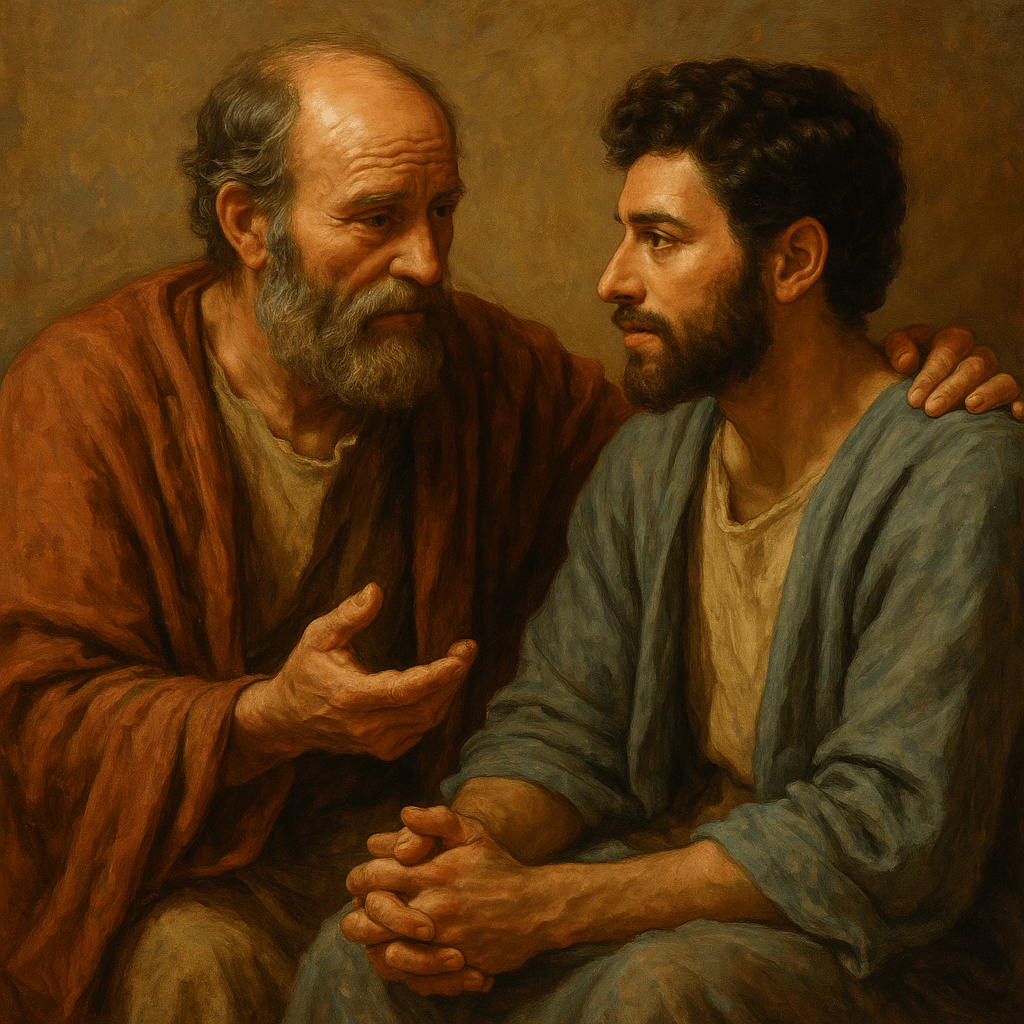
Legacy Begins in Relationship, Not the Spotlight
There’s a moment in every leader’s life when they realize that legacy doesn’t begin at the end of life—it begins in the lives we invest in today.
Before Paul ever instructed Timothy on doctrine, church leadership, or godliness, he wrote to him with the heart of a spiritual father. The opening verses of 1 Timothy aren’t just a formal greeting; they are a window into the kind of relationship that births legacy—one built on trust, truth, and time.
Too often we think of legacy as something we leave behind. But in the Kingdom of God, legacy is something we build daily—through words spoken in private, prayers whispered in faith, and the intentional investment we make in others. Paul didn’t wait until his ministry was finished to begin pouring into the next generation. He saw Timothy not as a project to manage, but as a son to nurture.
This short greeting—just two verses—tells us volumes about the way Paul saw his calling. His influence wasn’t measured by how many churches he planted or sermons he preached, but by how well he passed on the faith. And Timothy? He wasn’t just another young leader; he was the living evidence of Paul’s spiritual investment.
Real leadership doesn’t begin on a platform. It begins in proximity. With someone who knows your voice, feels your encouragement, and trusts your correction. That’s the kind of legacy that endures.
As we step into this series, let’s remember: You don’t need a title to lead, and you don’t need a stage to influence. You just need to be faithful with the lives God’s already placed around you. Because before God multiplies your reach, He always deepens your relationships.
The Power of Spiritual Fatherhood
Paul didn’t simply mentor Timothy—he claimed him as his “true child in the faith.” That language tells us something important: Paul saw Timothy not just as a protégé, but as family. He had watched this young man grow in faith, struggle in leadership, and rise to the calling God placed on his life. Paul’s letters weren’t cold instructions; they were filled with the warmth of a father’s heart and the urgency of someone passing on the torch.
This wasn’t leadership from a distance. It was discipleship forged in real-life proximity—walks between towns, conversations over meals, shared tears and victories. Paul wasn’t grooming Timothy for a position; he was forming him for a purpose. That kind of spiritual fatherhood doesn’t happen by accident. It’s slow, intentional, and deeply relational.
In a world chasing titles and platforms, Paul reminds us that leadership begins with relationship. Before influence comes investment.
And this principle still stands. Today’s young leaders aren’t looking for perfection—they’re looking for someone who will walk with them, speak truth with love, and stay when things get hard. They don’t need celebrity voices; they need faithful guides.
So pause for a moment and ask yourself:
Who has poured into your life—not just with content, but with character?
Who’s believed in you when you felt disqualified or discouraged?
And just as importantly—who are you investing in?
Legacy lives in the lives we touch. Spiritual fatherhood isn’t reserved for pastors or seasoned saints—it’s the invitation to every believer who’s known the grace of God and is willing to pass it on. Whether you’re twenty-five or sixty-five, God’s kingdom grows when we multiply what we’ve been given into someone else.
And maybe the most lasting thing you’ll ever do for the Kingdom isn’t what you build—but who you build.
Mentorship Matters
If you’ve ever been in a season where you felt called but unprepared, you’re in good company. Timothy knew that feeling well. He wasn’t Paul. He wasn’t the loudest, oldest, or most seasoned voice in the room. He was a young man with a big assignment—to help lead the church in a time of doctrinal confusion and cultural pressure. Can you imagine the weight of that responsibility?
But Timothy didn’t carry that weight alone. He had Paul. And that made all the difference.
Paul modeled mentorship that was both personal and powerful. He didn’t just give Timothy a list of expectations; he gave him presence. He gave him access to his life, his wisdom, and his encouragement. And because of that, Timothy stepped into his calling with a confidence rooted not in himself—but in the Lord.
We all need a Paul. Someone who sees what God is doing in us, even when we can’t yet see it ourselves. Someone who knows when to offer a challenge and when to offer comfort. Someone who reminds us that our purpose is bigger than our fear.
But the call doesn’t stop there—we’re also meant to be a Paul to someone else.
You don’t have to be a Bible scholar to be a mentor. You don’t have to have a perfect track record, just a surrendered heart and a willingness to show up. There’s someone younger in the faith, someone newer to the journey, who’s navigating questions you’ve already wrestled with—and they need your voice.
Mentorship isn’t about having all the answers. It’s about offering your availability, your authenticity, and your example.
You may not see the fruit immediately, but seeds planted in relationship will always grow with time. And often, the very things God has walked you through become the very things He uses to guide someone else.
So who’s your Timothy?
It could be the young adult in your small group who’s just learning to lead.
It could be a student, a co-worker, or even your own child.
It could be someone who’s looking at you and thinking, “I wonder if they’d care enough to show me the way.”
God’s design for leadership has always been generational—one life shaping another, one step at a time.
Embracing Spiritual Legacy
“Paul, an apostle of Christ Jesus by command of God our Savior and of Christ Jesus our hope,
To Timothy, my true child in the faith:
Grace, mercy, and peace from God the Father and Christ Jesus our Lord.”
— 1 Timothy 1:1–2 (ESV)
At first glance, Paul’s opening words to Timothy might seem like a standard introduction—but in the ancient world, how a letter began was never random. Every word carried weight. And in this brief greeting, Paul sets the tone for everything to follow. It’s a snapshot of spiritual authority, familial love, and divine empowerment.
To appreciate the richness of this passage, we need to understand the world in which Paul and Timothy lived.
Paul refers to himself as “an apostle of Christ Jesus by command of God.” This isn’t just a title—it’s a declaration of divine commissioning. In the Greco-Roman world, letters were often sent by emissaries on behalf of rulers or patrons. Paul adopts that model, asserting that he is a sent one, not self-appointed, but called by the direct order of God the Father and Christ Jesus.
This is especially important given the context of the early church. False teachers, many promoting legalistic distortions of the Mosaic Law or speculative myths, were undermining the Gospel’s purity and Paul’s authority. This makes Paul’s opening not just relational, but also a pre-emptive strike to establish spiritual clarity. So Paul’s words serve as both reassurance to Timothy and a public defense of his God-given leadership.
Timothy was a young man of mixed heritage—his mother was a Jewish believer and his father a Greek. Acts 16 tells us that he was well spoken of by the believers in Lystra and Iconium, and that Paul chose him as a traveling companion. Over time, Timothy became more than just an assistant; he became a spiritual son.
In Jewish culture, lineage and mentorship were tightly bound. A rabbi would often take on students (disciples), and those relationships were deeply formative. Paul uses similar language here, calling Timothy his “true child in the faith”. This is more than affectionate language—it’s covenantal. Paul is passing on not just information, but impartation. He sees himself in the role of a spiritual father—responsible for nurturing, correcting, and preparing Timothy for ministry.
Paul’s signature blessing—“grace, mercy, and peace”—was a unique combination not often found together outside of the Pastoral Epistles. While Greek letters typically began with a word of grace (charis), and Jewish greetings often invoked peace (shalom), Paul adds mercy into the mix—perhaps intentionally.
Why? Because ministry requires more than just favor and peace—it requires mercy. For the leader who falls short. For the flock that stumbles. For the times when strength fails and self-doubt sets in. Paul knew firsthand the weight of ministry and wanted Timothy to carry that tri-fold blessing into every challenge he’d face.
So what does this ancient greeting mean for us today?
These opening verses quietly but powerfully remind us that calling is not self-determined—it’s God-ordained. Like Paul, we are not leaders by preference or popularity, but by the command of the Lord. Our service flows from surrender, not self-promotion.
They also remind us that mentorship is sacred. Whether you’re in a season of being a Paul or a Timothy, God often does His deepest work through spiritual relationships. Leadership isn’t meant to be a solo pursuit—it’s meant to be shared, multiplied, and passed on.
And finally, we’re reminded that we lead with grace, mercy, and peace—not pressure. These aren’t just poetic blessings; they’re essential supplies for the road ahead. When leadership feels heavy, when criticism comes, or when failure stings—these are the gifts that sustain us.
In a world still infatuated with credentials, platforms, and influence, Paul’s words flip the narrative. Legacy isn’t built through resume lines—it’s built through relationships. And true authority? It isn’t seized. It’s entrusted by God and stewarded with humility.
Living It Out: Building a Legacy Through Intentional Relationship
If there’s one truth that rises from these opening verses, it’s this: legacy begins with relationship, not recognition. Paul’s words to Timothy weren’t crafted for applause—they were born out of authentic investment in someone he believed in.
So take a moment to pause and reflect.
Who has been your Paul? Who has poured into your life—not just with teaching, but with presence? Maybe it was a parent, a pastor, a small group leader, or a friend who walked with you through doubt and helped you grow in your faith. If they’re still around, reach out. Say thank you. Let them know their investment mattered.
And then ask: who’s your Timothy? Is there someone in your life who could benefit from the lessons you’ve learned—the struggles you’ve faced, the grace you’ve received? They don’t need someone perfect; they need someone present.
Legacy doesn’t demand a platform. It starts with small, sacred steps.
A text message to your mentor.
A coffee date with someone younger in the faith.
A simple invitation to walk together through Scripture or prayer.
These everyday moments—often unseen and uncelebrated—are where legacy is quietly forged. Influence that lasts isn’t flashy; it’s faithful. And the greatest investment you can make for the Kingdom might not be what you build, but who you build.
So don’t chase influence. Cultivate it—one relationship at a time.

A Field at Your Feet
Your life is not a random string of moments. It’s a field—rich with potential, sacred with purpose. And every decision, action, thought, and intention is a seed dropped into that soil. Whether it’s a conversation with your child, a choice made in secret, or a thought you entertain in silence, you are sowing something. Moment by moment, we are cultivating a future harvest—often without even realizing it. The question isn’t whether you’re sowing; the question is what you’re planting and where you’re planting it.
Will the fruit of your life nourish the soul and glorify God, or will it wither under the weight of selfishness and shortsighted choices?
The apostle Paul speaks directly to this in his letter to the Galatians:
“Do not be deceived: God is not mocked, for whatever one sows, that will he also reap. For the one who sows to his own flesh will from the flesh reap corruption, but the one who sows to the Spirit will from the Spirit reap eternal life. And let us not grow weary of doing good, for in due season we will reap, if we do not give up.”
— Galatians 6:7–9
This passage doesn’t offer a helpful tip for better living—it declares a spiritual law etched into the very fabric of creation. Like gravity, it applies to everyone. Our sowing is inevitable. Our harvest is unavoidable. You cannot mock God by sowing one kind of seed and expect a different kind of fruit. The life you are cultivating today—through your habits, your words, your relationships, your quiet choices—will bear fruit. The only question is whether it will be fruit of the flesh or of the Spirit.
This is where we must pause and look closely. What are the fields of our lives revealing? What kind of seeds are we sowing—daily, intentionally or unintentionally?
Let’s walk through the two fields Paul describes—flesh and Spirit—and see how every seed we sow today is shaping not just our tomorrow, but our eternity.
Two Fields, Two Outcomes
Paul presents us with a sobering yet hope-filled dichotomy in Galatians 6: we are all sowing into one of two fields—the field of the flesh or the field of the Spirit. There is no neutral ground. Every thought entertained, every decision made, and every priority established is a seed being sown in one direction or the other. And each field produces a predictable harvest: the flesh reaps corruption, while the Spirit yields eternal life.
But let’s be honest—sowing to the flesh doesn’t always look evil on the surface. It’s rarely a blatant act of rebellion. More often, it’s a slow, quiet drift. It’s choosing comfort over calling. It’s being more concerned with your image than your integrity. It’s allowing convenience to shape your choices instead of conviction. It’s not that we stop believing in God—it’s that we start living like He’s not really relevant to the daily grind.
Living for the flesh is ultimately living for now—the immediate, the visible, the temporary. It’s pouring your best energy into things that won’t matter five years from now, let alone five hundred. We chase recognition, possessions, platforms, and security, thinking they’ll satisfy—yet they never do. That’s the deception of the flesh: it promises fulfillment but delivers emptiness.
In contrast, sowing to the Spirit isn’t about earning God’s love or trying to impress Him with perfect behavior. It’s about living with eternal intention. It’s a life reoriented around Christ—where your decisions, desires, and direction are guided by the Holy Spirit and anchored in Scripture. It’s waking up each day asking not, “What do I want to do?” but “What would honor God today?” Jesus didn’t just model a Spirit-led life—He sowed His very life in obedience, even unto death, so we could reap the life He secured for us. Our sowing isn’t powered by willpower, but by grace.
Jesus called this mindset storing up treasures in heaven (Matthew 6:19–21). It’s a life invested in things that outlive us—like faithfulness, obedience, love, truth, and compassion. These are seeds that never spoil and never return void. The good news? You don’t have to be a pastor, missionary, or theologian to sow to the Spirit. You simply have to walk in step with Him. It’s not about perfection; it’s about direction.
And direction is shaped by daily decisions.
Which brings us to the beauty and power of what happens when small seeds are sown with eternal purpose.
Small Seeds, Eternal Impact
The most transformative moments in life often begin with the smallest seeds—ones that feel insignificant in the moment but carry weight in eternity. A kind word spoken when it wasn’t required. A prayer whispered when no one was watching. A generous gift offered when it wasn’t convenient. A moment of obedience when turning away would’ve been easier.
God’s economy works differently than ours. We often look for instant results—something flashy, measurable, or celebrated. But the Spirit works like a seed: hidden, slow-growing, and sometimes seemingly silent. That’s why Paul exhorts us,
“Let us not grow weary of doing good, for in due season we will reap, if we do not give up”
– Galatians 6:9
Faithfulness today leads to fruitfulness tomorrow.
But let’s be real—it’s easy to get discouraged when we don’t see the harvest right away. You show up, serve, give, pray, forgive—and it can feel like nothing’s changing. That’s why we need to remember: God never wastes a seed sown in the Spirit. Every act of obedience, no matter how small, is building something in the unseen that will one day be revealed. Sometimes, the harvest isn’t for you—it’s for the generation coming after you.
Jesus said that the kingdom of God is like a mustard seed—
“the smallest of all seeds, but when it has grown it is larger than all the garden plants and becomes a tree”
– Matthew 13:31–32
The seed seems small, but its potential is staggering. In the same way, the things you sow today in faith can become spiritual shelter and nourishment for others tomorrow.
So don’t overlook the power of small, Spirit-led decisions. A consistent time in God’s Word. Choosing to forgive instead of hold a grudge. Taking time to listen instead of rushing through a conversation. Prioritizing your family when it would be easier to numb out. These are the seeds that shape legacies.
What you plant in the soil of today will grow into the fruit of your tomorrow—and into someone else’s eternity.
Don’t Give Up—The Harvest Is Coming
Paul’s words are both a challenge and a comfort:
“Let us not grow weary of doing good, for in due season we will reap, if we do not give up.”
– Galatians 6:9
This implies something we all face: weariness. Sowing to the Spirit isn’t always exciting. It can feel thankless, unnoticed, and even unrewarded—especially when others around you seem to be reaping a different kind of reward by sowing to the flesh.
But Paul reminds us: the harvest doesn’t come overnight. Just because we don’t see immediate fruit doesn’t mean our obedience is in vain. God operates on His own timeline, and He is never late. The “due season” will come—not by chance, but by promise. Our job isn’t to force the harvest; it’s to remain faithful in the planting.
Think of Noah, who built an ark for years with no rain in sight. Or Joseph, who honored God in obscurity long before he saw the fulfillment of his dreams. Or Jesus Himself, who sowed His very life in suffering before the resurrection came. The pattern of the kingdom is perseverance before reward, planting before reaping, dying to self before life springs forth.
And sometimes, the harvest is spiritual maturity. Sometimes, it’s peace that surpasses understanding. Sometimes, it’s seeing someone else’s life transformed because of your quiet faithfulness. But always, it’s worth it.
So if you’re tired—don’t quit. If you feel unseen—God sees. If the fruit seems slow—trust the root is growing deep. The Spirit’s work is never wasted, and your labor in the Lord is never in vain (1 Corinthians 15:58). Keep showing up. Keep planting. Keep trusting.
Because the soil may be quiet, but the harvest is on its way.
What Are You Planting Today?
The real issue isn’t whether you’re planting—it’s what kind of seeds you’re choosing, and into which field. Every moment, every decision, every attitude is a seed sown. And every seed carries the DNA of its future. The harvest you’ll reap tomorrow is rooted in what you’re planting today.
Galatians 6:7–9 isn’t meant to scare us; it’s meant to sober us—to awaken us to the reality that this life matters more than we think. We are eternal beings, and our choices carry eternal weight. The seeds we sow with our time, our words, our relationships, and our resources are either building a legacy of faith or feeding the desires of the flesh.
Here’s the good news: it’s never too late to start sowing differently. God’s grace meets us right where we are and invites us to live with new intention. You may have spent years scattering seeds that bore regret—but today, you can begin to sow to the Spirit. No matter what’s grown in your field before, today the soil is soft again—ready for new seeds, new growth, new life. Today, you can plant what will lead to life.
So let this be your challenge:
Live in such a way that your life outlives you.
Sow seeds of faith that will bloom in the lives of your children, your church, your community, and generations to come. Speak words that build. Make sacrifices that reflect Christ. Invest your time in things that matter. Plant gospel seeds that someone else might harvest years from now.
Sow seeds of faith that point others to Jesus, that make disciples, and that pass down a living faith to generations you may never meet.
Because legacy isn’t built in a moment—it’s built in the quiet, faithful planting of one seed at a time.
Let’s not waste our lives planting what withers. Let’s be people who sow into things that outlive us—things that glorify God, bless others, and bear fruit that remains.
Your life is a seed.
Plant it in faith.
Water it with obedience.
And trust God for a harvest that reaches into eternity.

It’s a strange emptiness—when you get the recognition you craved, only to wonder why you still feel unfulfilled.
If you’re anything like me, you’ve felt the subtle pull of wanting to be seen, appreciated, and affirmed by those around you. Maybe it’s the number of likes on a post, the quiet approval of friends, or even the respect we hope to earn in our church or workplace. In today’s world, where comparison is almost unavoidable, it’s easy—even for Christians—to start living for the applause of others instead of the eternal purpose God has placed on our lives.
This struggle is real. I’ve wrestled with it myself—wondering if I’m measuring up, feeling the weight of insecurity, and battling that nagging emptiness when approval fades. The culture around us distorts what it means to be successful and valuable, leading us away from the deep, lasting identity found only in Christ.
That’s why Paul’s words in Galatians 1:10 hit home for me:
“For am I now seeking the approval of man, or of God? Or am I trying to please man? If I were still trying to please man, I would not be a servant of Christ.”
This question cuts through all the noise—who are we really living to please? Man’s applause is fleeting and fragile, but God’s approval brings true freedom and purpose.
If you’re sensing that you might be caught up in living for applause rather than purpose, you’re not alone. Let’s take a closer look at three signs of this struggle and how we can reorient our hearts toward God’s eternal calling.
Sign #1: You Measure Your Worth by Comparison
Comparison is a silent thief of joy and peace. In our culture, it’s easy to fall into the habit of measuring ourselves against others—whether it’s in career achievements, ministry influence, appearance, or social media presence. But Scripture calls us to a profoundly different standard, one rooted not in performance or approval, but in our identity as God’s beloved workmanship.
Paul reminds us in Ephesians 2:10 that,
“we are his workmanship, created in Christ Jesus for good works, which God prepared beforehand, that we should walk in them.”
Your worth is not found in outdoing someone else or trying to keep up with a worldly standard, but in embracing the unique calling God has designed just for you. When you fall into the comparison trap, it’s easy to doubt God’s perfect design for your life and lose sight of His purpose.
Consider Moses—God’s chosen leader who wrestled with feelings of inadequacy and fear (Exodus 3-4). He didn’t succeed because he measured up to others but because he trusted God’s call and obeyed despite his doubts. Like Moses, your path is uniquely yours, prepared by God in advance.
The Bible offers a sober warning in 2 Corinthians 10:12:
“When they measure themselves by themselves and compare themselves with themselves, they are without understanding.”
Comparison breeds envy, discouragement, and a distorted view of success—all of which can hinder your spiritual growth.
Take time to reflect honestly: Where are you tempted to compare yourself to others? Ask God to help you see yourself through His eyes, to embrace your unique calling, and to find your worth firmly in Christ alone. Remember, your value is not in how you stack up but in who you are in Him.
Sign #2: You Fear Being Overlooked More Than Being Faithful
There is a deep desire in all of us to be seen and valued. But when this desire becomes a driving force, it can lead to anxiety, exhaustion, and a faith shaped more by human applause than by God’s approval. The fear of being overlooked tempts us into performing for others or avoiding faithful service when it doesn’t bring recognition.
Jesus clearly warns us in Matthew 6:1-4:
“Beware of practicing your righteousness before other people in order to be seen by them… But when you give to the needy, do not let your left hand know what your right hand is doing.”
Faithfulness often happens in quiet, unseen ways that the world overlooks—but God notices.
Jesus’ own ministry was marked by this truth. Though He attracted crowds, much of His work happened in private prayer, humble service, and enduring rejection (John 5:41-44). His example invites us to fix our eyes on pleasing the Father rather than seeking fleeting human praise.
When fear of being unseen grips your heart, it reveals an idol—the need for human approval. This fear can cause you to chase popularity, shy away from difficult tasks, or even give up prematurely.
Ask God to reveal where you might be serving for applause rather than obedience. Practice faithfulness in small, unseen acts—whether at home, church, or work—and trust that God watches over every act of obedience (Psalm 121:4). Let His steadfast love be your security, not the fleeting gaze of others.
Sign #3: You Feel Empty After the Applause Dies
The applause of the world is intoxicating, but it’s also temporary. Many have chased recognition only to discover a hollow place afterward. This emptiness is a spiritual signal—applause can never replace the deep satisfaction found in God’s purpose.
King Solomon, who experienced all worldly success and acclaim, confesses this in Ecclesiastes 2:11:
“Then I considered all that my hands had done and the toil I had expended in doing it, and behold, all was vanity and a striving after wind, and there was nothing to be gained under the sun.”
Without God, even our greatest achievements leave us empty.
True joy and lasting satisfaction come only when we align our lives with God’s eternal purpose. Paul, despite suffering and imprisonment, declares in Philippians 3:8:
“Indeed, I count everything as loss because of the surpassing worth of knowing Christ Jesus my Lord.”
When our lives are grounded in knowing and serving Christ, the applause of this world fades in comparison to the eternal joy that fills our souls.
Reflect honestly on where you turn when recognition fades. Are you clinging to temporary validation or rooted in the presence of Christ? Daily surrender your achievements and accolades to God, asking Him to fill the emptiness applause can’t touch. Let your heart be anchored in His eternal promises.
Eternal Applause: Choosing What Lasts
Comparison culture may be loud and persistent, but its voice pales in comparison to the quiet call of Christ—beckoning us to a better way. The applause of man is fleeting; it fades as quickly as it comes. But the affirmation of the Father is eternal, unshakable, and full of peace.
Living for God’s glory is not about grand gestures or public recognition—it’s about daily faithfulness in unseen spaces, where your heart beats in rhythm with His. The world may never notice, but heaven rejoices.
Jesus asked in Mark 8:36,
“For what does it profit a man to gain the whole world and forfeit his soul?”
The applause of the crowd may feel satisfying for a moment, but it cannot nourish your soul. Only the approval of Christ—the One who gave Himself for you—can fill the deep hunger for significance.
You were never meant to carry the burden of performing for others. You were created for intimacy with God and impact through obedience. Ephesians 2:10 doesn’t just describe what you do—it defines who you are: His workmanship, His masterpiece.
So trade the stage for the secret place. Surrender the pressure to be impressive and choose instead to be faithful. Let your life resound with eternal purpose—whether anyone sees or not.
One day, the applause of earth will go silent. But there is a coming moment when those who walked humbly and lived obediently will hear the only words that truly matter:
Well done, good and faithful servant.
– Matthew 25:23
Live for that moment. That applause. That reward.
This week, ask God to reveal where applause may be driving your choices. Meditate on John 12:43 and ask yourself—whose approval are you living for?

 Pastor Luke

Recent Comments