
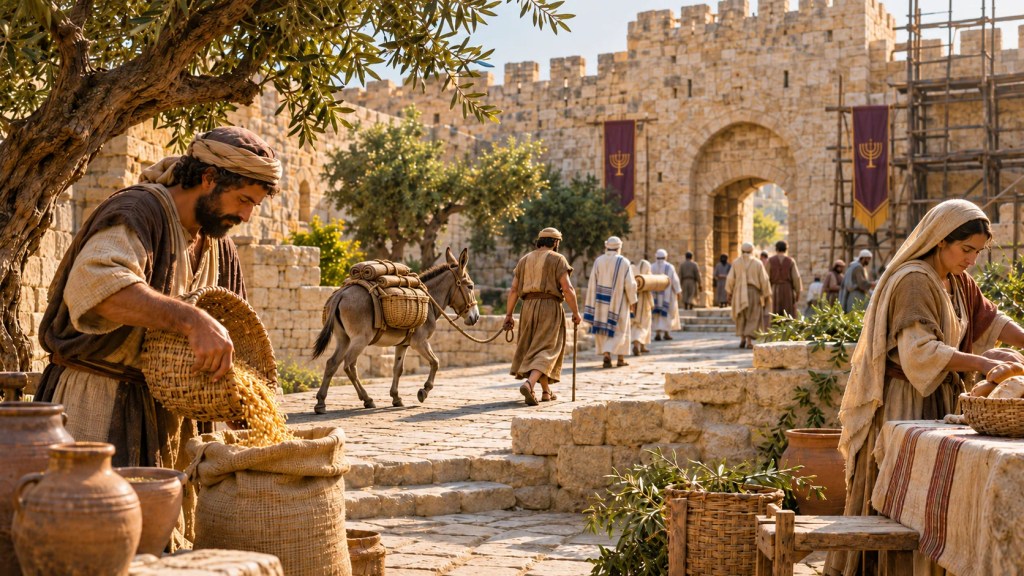
“And the joy of Jerusalem was heard far away.”
— Nehemiah 12:43 (ESV, excerpt)
“Remember me, O my God, for good.”
— Nehemiah 13:31 (ESV, excerpt)
There’s a particular kind of discouragement that comes when you notice yourself slipping back into something you worked hard to change. Maybe you catch yourself responding defensively after learning to communicate with more patience, or see old habits beginning to strain a relationship you’ve spent months restoring. It’s not simply the setback that bothers you. It’s wondering whether the progress you celebrated will actually last.
Real change can be meaningful without being complete. We can make genuine progress, experience restoration, and still discover that faithfulness requires more than one important decision or season of effort. That’s often hardest to recognize after we’ve finally reached a milestone. We want to enjoy what’s been accomplished, and we should, but life doesn’t stand still once the celebration ends.
That tension is part of what makes the conclusion of Nehemiah so unexpected. Throughout this series, we’ve followed a journey marked by prayer, opposition, rebuilding, and renewed attention to God’s Word. By these final chapters, there’s a lot to celebrate, and the people certainly do. But the book doesn’t conclude with the triumphant ending we might anticipate. Instead, the final chapter raises some uncomfortable questions about everything that’s taken place.
As we finish this journey, we’re confronted with something worth considering in our own lives. What happens when the excitement fades, ordinary responsibilities return, and the commitments we’ve made are tested over time? Nehemiah’s conclusion challenges us to look beyond what we’ve accomplished and consider what it actually means to remain faithful.
The World Behind the Text
By the time we reach Nehemiah 11, the walls are finished, but there’s still work to be done among the people living inside them. They’ve gathered around God’s Word, confessed their sin, and made serious commitments about how they’ll live as His people. Those commitments weren’t limited to religious ceremonies. They involved their families, their weekly rhythms, and the way they supported the worship of God. Now they faced the responsibility of putting those promises into practice beyond the moments of conviction and celebration.
There was also a practical challenge that the rebuilt walls hadn’t resolved. Nehemiah 7:4 tells us that Jerusalem was a large city, but very few people lived there. If the city was going to thrive, it needed more than protection. It needed families willing to make it their home, people to carry responsibilities, and an organized community that could sustain its daily life and worship. That’s part of what makes these final chapters important. The people weren’t just celebrating what had been restored. They were beginning to live with the responsibilities that came with it.
There’s one more detail worth keeping in mind as we approach chapter 13. Nehemiah tells us that he returned to the Persian king during the thirty-second year of Artaxerxes’ reign, around 433 BC. Sometime later, he received permission to return to Jerusalem, although Scripture doesn’t tell us exactly how long he’d been gone. That matters because we shouldn’t assume everything in these chapters happened immediately after the people renewed their covenant. Time had passed, and Nehemiah was returning to a community that had been responsible for living out its commitments in his absence.
Beyond the Wall: Understanding Nehemiah 11–13
Nehemiah 11 begins by addressing the population problem we’ve just discussed. Jerusalem’s leaders already lived within the city, but more residents were needed. The people cast lots to determine which families would relocate, selecting about one out of every ten, while others volunteered willingly and received the community’s blessing. The remainder of the chapter identifies residents, officials, priests, Levites, gatekeepers, and families living in the surrounding towns. Following the dramatic opposition and spiritual renewal we’ve encountered throughout the book, these administrative details may seem anticlimactic. But they demonstrate that Jerusalem’s restoration required more than standing walls. It needed people willing to establish their lives there and fulfill the responsibilities of a functioning community.
Chapter 12 begins with records of priests and Levites associated with different generations of the restored community. These genealogies connect those serving in Nehemiah’s day with earlier generations that had returned from exile. Their inclusion demonstrates continuity in Israel’s worship and reinforces that Jerusalem’s restoration wasn’t intended to establish something disconnected from its covenant history. The people were restoring communal life and organized worship according to the responsibilities God had already given them.
Beginning in Nehemiah 12:27, the narrative moves into one of its most joyful moments. The people gather to dedicate the rebuilt wall, bringing Levites and musicians to Jerusalem for a celebration that includes purification, thanksgiving, and two great choirs moving along the wall before gathering at the house of God. Nehemiah 12:43 tells us that God had given the people great joy, with men, women, and children participating in a celebration that could be heard far away. After everything they’d endured, their response wasn’t simply admiration for their own achievement. They recognized God’s faithfulness and responded with joyful worship.
The celebration was followed by practical arrangements for maintaining temple worship. Nehemiah 12:44–47 describes the appointment of men to oversee the contributions, firstfruits, and tithes that supported the priests, Levites, singers, and gatekeepers. These provisions belonged to Israel’s covenant obligations and were necessary for sustaining the temple service God had established. The people weren’t simply celebrating what had been accomplished. They were arranging for the responsibilities of worship to continue, although chapter 13 would reveal how easily those arrangements could be neglected.
Nehemiah 13 opens with another reading from the Book of Moses. The people encounter instructions excluding Ammonites and Moabites from the assembly of God because of their historical opposition to Israel, including their refusal to provide assistance during the wilderness journey and their attempt to bring a curse upon God’s people. In response, the people separate those of foreign descent from Israel. This is a difficult passage because it involves genuine boundaries within Israel’s covenant community, and we need to be careful not to interpret those boundaries as a timeless prohibition against people of different nationalities or ethnic backgrounds. Ruth was a Moabite woman who turned to Israel’s God, while Isaiah 56 anticipates faithful foreigners being welcomed in worship. Those passages don’t erase Nehemiah’s account, but they remind us that Israel’s covenant identity and the treatment of outsiders require more careful consideration than ancestry alone. These historical regulations also shouldn’t be transferred directly to the church under the new covenant.
The narrative then reveals a troubling compromise involving Tobiah, who had previously opposed Jerusalem’s rebuilding. Eliashib, a priest responsible for the temple storerooms who was related to Tobiah, had provided him with a large chamber inside the temple complex. This space had been designated for offerings and provisions supporting the Levites and other temple servants. When Nehemiah returned and discovered the arrangement, he removed Tobiah’s belongings, ordered the chambers to be cleansed, and restored the temple articles and offerings. A space intended to support God’s worship had been diverted to someone whose interests had repeatedly conflicted with Jerusalem’s restoration.
Nehemiah also discovered that the Levites hadn’t been receiving their assigned portions, causing those responsible for temple service to return to their fields to support themselves. He confronted the officials, gathered the Levites back to their duties, and appointed trustworthy men to oversee the restored distribution of contributions. This failure was particularly significant because the people had specifically committed themselves not to neglect the house of God in chapter 10. The arrangements established to sustain worship had been neglected, revealing how the community’s actions had become inconsistent with its earlier commitments.
Nehemiah concludes this account with a prayer, asking God to remember his service to His house (Nehemiah 13:14). His appeal shouldn’t automatically be understood as prideful or as an attempt to earn God’s favor. Rather, Nehemiah places his actions before the God who sees and remembers his service. Even as he works to restore order, prayer remains central to his leadership.
Nehemiah 13:15–22 reveals another area where the people had abandoned their commitments. Nehemiah observed people pressing grapes, transporting goods, and conducting business on the Sabbath. Merchants from Tyre were also bringing merchandise into Jerusalem, where the people continued buying and selling on a day God had commanded Israel to keep holy. This directly violated their promise in Nehemiah 10:31. Nehemiah confronted Judah’s nobles, reminding them of the consequences their ancestors’ disobedience had brought upon Jerusalem. He ordered the gates closed before the Sabbath and guarded until it ended, even warning merchants who gathered outside that he would use force if they returned.
These actions reflected Nehemiah’s authority within Israel’s covenant community, where the Mosaic Law governed religious and public life. Christians aren’t called to enforce the Sabbath through the same regulations or governmental authority. Nevertheless, the historical offense is clear: the people were disregarding a command they’d explicitly promised to obey. Nehemiah concludes this confrontation by asking God to remember his efforts and spare him according to His steadfast love (Nehemiah 13:22). Even as he worked to restore obedience, he appealed to God’s mercy rather than treating his service as something that placed God under an obligation.
The final major problem appears in Nehemiah 13:23–29, where Nehemiah discovers marriages involving women from Ashdod, Ammon, and Moab. He also observes that many of their children couldn’t speak the language of Judah, although Scripture doesn’t explicitly say they were unable to understand God’s Word. Nehemiah regarded these developments as a threat to the community’s covenant faithfulness, particularly because of the danger of religious compromise. He recalled how Solomon, despite his extraordinary wisdom and privilege, had been led into sin through foreign wives who turned his heart toward other gods. Once again, the community was violating a commitment it had made in chapter 10.
The compromise had even reached the priestly leadership. One of the sons of Joiada, from the high-priestly family, had married a daughter of Sanballat, a persistent opponent of Jerusalem’s rebuilding. Nehemiah drove him away and prayed that God would remember those who had defiled the priesthood. His response to the broader marriage violations also included cursing offenders, striking some of them, pulling out their hair, and requiring an oath concerning future marriages. These details are uncomfortable, and we shouldn’t overlook them. Yet Scripture’s description of Nehemiah’s actions doesn’t mean Christians are commanded to imitate every aspect of his conduct. His historical authority and Israel’s covenant obligations must be distinguished from the New Testament’s instructions to correct others with gentleness and patience (Galatians 6:1; 2 Timothy 2:24–25). We can recognize the seriousness of the violations without treating physical force or humiliation as acceptable methods of Christian leadership.
The book closes with Nehemiah summarizing his efforts to restore order among the priests and Levites, establish their responsibilities, and provide for the appointed offerings. Then he ends with one final prayer, asking God to remember him for good (Nehemiah 13:30–31). It’s a striking conclusion because we aren’t told that the community finally overcame its pattern of disobedience or that Nehemiah’s latest reforms would endure. Instead, the account ends with a leader who had accomplished remarkable things while still confronting the persistent unfaithfulness of the people he served.
The contrast between chapters 12 and 13 gives these final events their significance. In chapter 12, the people celebrated the restoration of Jerusalem with thanksgiving and worship. In chapter 13, Nehemiah found that several of their earlier covenant commitments were no longer being honored. His efforts addressed those failures, but the book doesn’t tell us what happened after his final reforms. Rather than offering a triumphant resolution, Nehemiah leaves us with the reality of a restored city and a community whose continued faithfulness remained uncertain.
From Celebration to Continued Faithfulness
There’s a difference between making an important commitment and continuing to live it out. Sometimes the initial decision requires tremendous courage, especially when we’re confronting something that’s been broken or neglected for a long time. But once we’ve taken that step, a different kind of faithfulness is required. We have to continue making choices that reflect what we’ve committed ourselves to, often in ordinary circumstances where the excitement and urgency of the original moment are no longer present.
That’s where the final chapters of Nehemiah begin speaking into our own lives. We aren’t living under the same covenant arrangements as ancient Israel, and we’re not called to reproduce its temple system or Nehemiah’s methods of enforcing the Law. But as followers of Christ, we’re still called to live in obedience to God’s Word, remain attentive to the work of His Spirit, and faithfully steward what He’s entrusted to us. Those responsibilities don’t disappear when we reach an important milestone, and our past progress doesn’t eliminate our need for continued growth.
1. Keep Investing in What God Has Entrusted to You
It’s easy to invest significant effort into reaching a goal while giving less thought to what happens afterward. We work hard to establish something healthy, overcome a difficult situation, or make meaningful changes in our lives. But once we’ve made progress, our attention often shifts toward the next challenge. Meanwhile, the relationships, responsibilities, and commitments we’ve already invested in can begin receiving less attention than they deserve. What we’ve worked so hard to establish still needs to be cared for.
Consider the responsibility of leading a ministry or caring for your family. Significant milestones are worth celebrating, but the people involved still need our attention long after those moments have passed. Relationships require continued investment, healthy routines need consistency, and responsibilities must be carried out faithfully. That doesn’t mean we have to maintain everything ourselves or continue every commitment indefinitely. Sometimes faithful stewardship requires developing others, sharing responsibilities, or establishing healthier rhythms that allow us to care well for what God has entrusted to us.
So take a moment to consider: What have I worked hard to establish that now needs more intentional care? Maybe it’s a relationship you’ve gradually neglected, a responsibility that’s been pushed aside, or a healthy practice you’ve allowed to fade. Instead of immediately pursuing something new, perhaps the next faithful step is returning your attention to something God has already placed in your hands. It may not require another major decision or extraordinary effort, but a renewed commitment to the ordinary, consistent actions that demonstrate faithful stewardship.
2. Celebrate God’s Faithfulness Without Becoming Complacent
Sometimes we’re so focused on what still needs to be done that we barely stop to recognize what God has already accomplished. We move from one challenge to another, continuing to pray about the next concern without taking much time to thank Him for the prayers He’s already answered. But there’s another danger worth recognizing. We can become so comfortable with the progress we’ve experienced that we begin to assume everything is going well spiritually. Both tendencies can distract us from recognizing our continued dependence on God.
The celebration in Nehemiah 12 reminds us that recognizing God’s faithfulness is an important part of our relationship with Him. The people had every reason to rejoice, and Scripture tells us that God had given them great joy. Their celebration wasn’t simply about accomplishing something difficult. It was an opportunity to worship the One who had sustained them through it. We need those moments in our own lives, too. Whether it’s a restored relationship, a season of spiritual growth, or an answered prayer, we should take time to recognize God’s goodness. But genuine gratitude should also keep us humble, reminding us that the God who brought us this far is the same One we continue to need every day.
Think about something God has brought you through or an area where you’ve experienced meaningful growth. Have you taken time to thank Him for what He’s done, or have you already moved on to the next concern? Perhaps you’ve acknowledged His goodness but gradually become less intentional about seeking Him because life feels more stable. Take time to remember and celebrate His faithfulness, but don’t allow yesterday’s blessings to replace today’s dependence on Him. We can rejoice in what God has accomplished while remaining attentive to where He’s still calling us to grow. Gratitude should never become an excuse for complacency. Instead, it should deepen our worship, strengthen our trust, and encourage us to keep walking faithfully with Him.
3. Recognize Spiritual Drift and Return to Obedience
One of the more sobering realities of the Christian life is that we can make sincere commitments and still find ourselves returning to old patterns. We recognize an attitude that needs to change, confront a recurring sin, or make a decision to live differently, and our intentions are genuine. But as time passes, we can gradually become comfortable with things we once recognized needed attention. Sometimes the change happens so slowly that we barely notice it. We begin making exceptions, justifying certain behaviors, or neglecting what we know God has called us to do. Before long, there’s a growing distance between what we say we believe and how we’re actually living.
That’s why we need to remain willing to examine our lives in light of God’s Word. Spiritual maturity doesn’t mean reaching a point where we no longer need correction. It means becoming increasingly responsive when the Lord reveals something that needs to change. Maybe you’ve recognized that pride is influencing how you respond to criticism, but you’ve continued defending yourself instead of listening. Perhaps there’s an unhealthy pattern in your life that you’ve repeatedly excused because confronting it would require an uncomfortable decision. Rather than dismissing those convictions or simply feeling disappointed in ourselves, we need to respond with repentance that leads to meaningful change. That might involve having a difficult conversation, making something right, establishing boundaries, or inviting someone we trust to help hold us accountable.
So consider this question: Where have I gradually become comfortable with something God has already called me to address? The purpose isn’t to make ourselves feel guilty about every weakness or question whether any previous growth was genuine. It’s to remain humble and willing to respond when God confronts us with His truth. And when we recognize that we’ve drifted, we don’t have to depend entirely on our own determination to change. We can confess our sin, receive His forgiveness, and rely on the continued work of His Spirit as we take practical steps of obedience. Yesterday’s faithfulness doesn’t guarantee tomorrow’s, but God’s grace is sufficient for us to continue walking with Him today.
The Work That Lasts
When we first encountered Nehemiah, he was serving in the court of a Persian king when he received troubling news about Jerusalem. What he heard broke his heart and drove him to prayer, but it also moved him to action. Throughout this series, we’ve watched that burden develop into courageous leadership, faithful perseverance, and the remarkable restoration of Jerusalem’s walls. We’ve seen God’s people overcome opposition, confront injustice, rediscover His Word, and experience genuine moments of repentance and renewal. There’s much to celebrate in everything God accomplished through Nehemiah and the people who joined him.
But the book’s ending reminds us that even remarkable accomplishments have their limitations. Nehemiah could rebuild the walls, establish systems of accountability, and confront disobedience, but he couldn’t guarantee that the people would remain faithful. Their recurring struggles didn’t make the work of restoration meaningless, but they revealed a deeper need that human leadership and external reform couldn’t resolve. The people didn’t simply need better circumstances or stronger commitments. They needed the kind of inward transformation that only God could provide.
That’s what makes the promises of Jeremiah 31:31–34 and Ezekiel 36:26–27 so significant. God had promised a new covenant in which His law would be written upon the hearts of His people, and He would give them new hearts and place His Spirit within them. Those promises find their fulfillment in Jesus Christ. He identified His coming death with the new covenant (Luke 22:20), and Hebrews 8 explains how His ministry fulfills that promised covenant. Through His death and resurrection, Jesus accomplishes what our efforts and good intentions never could. Through Him, we’re forgiven and reconciled to God, and by His Spirit, we’re being transformed into people who increasingly reflect His character. We still struggle, stumble, and need repentance, but our hope doesn’t rest in the strength of our determination. It rests in the faithfulness of the One who has redeemed us and continues His work within us.
As we close this journey through Nehemiah, I think it’s worth remembering that the goal was never simply to admire a capable leader or learn how to accomplish difficult things. Those lessons certainly have value, but Scripture invites us to consider something much deeper. We can spend our lives building ministries, raising families, developing relationships, and pursuing meaningful responsibilities, but none of those accomplishments can replace a faithful relationship with the Lord. What we build matters, but it can never become more important than our relationship with the One who has called us to build it.
Nehemiah began with a broken heart and a prayer. He finished with a restored city, a community still in need of renewal, and another prayer. His story reminds us that finishing well doesn’t mean reaching a place where we no longer need God’s help. It means continuing to depend on Him, remaining responsive to His Word, and faithfully following Him through every season of life. So as we consider everything we’ve learned throughout this series, perhaps the most important question isn’t simply what we’re building, but whether we’re allowing God to continue His work within us. Because ultimately, what lasts isn’t secured by the strength of our accomplishments, but by the faithfulness of the God who calls us, sustains us, and continues transforming us through Jesus Christ.
Explore Related Writings
Continue exploring faithful leadership, repentance, and spiritual renewal throughout the Building What Lasts series.

Repentance & Renewal
God’s faithfulness leads His people toward confession, renewed commitments, and obedience.
Staying Focused on the Mission
Explore perseverance and discernment when opposition threatens faithful work.

A Leader with a Broken Heart
Return to the burden and prayer that began Nehemiah’s journey.


Leave a Reply