
Life Under the King (Part 1): The King on the Mountain
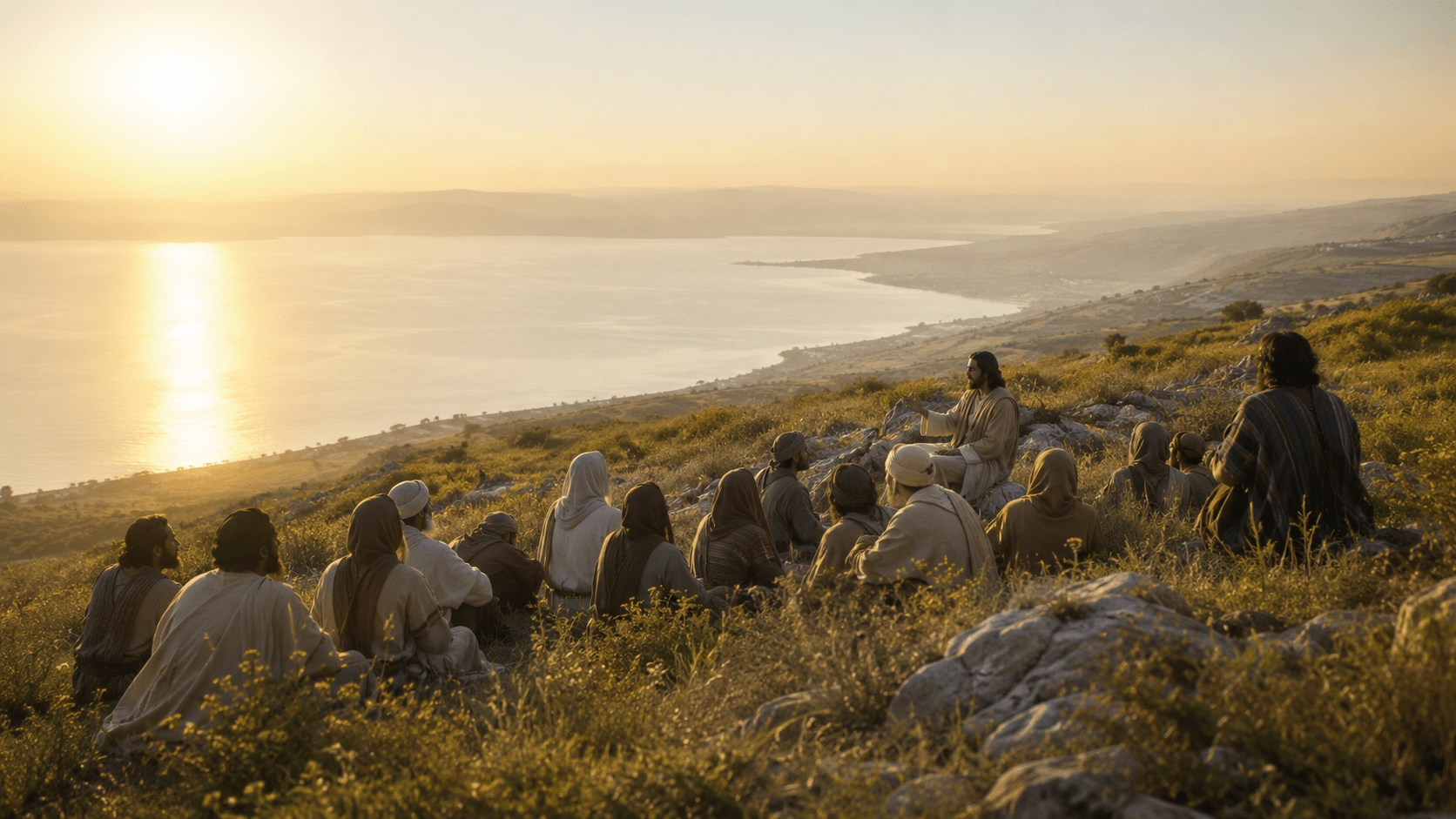
“And he went throughout all Galilee, teaching in their synagogues and proclaiming the gospel of the kingdom and healing every disease and every affliction among the people. So his fame spread throughout all Syria, and they brought him all the sick, those afflicted with various diseases and pains, those oppressed by demons, those having seizures, and paralytics, and he healed them. And great crowds followed him from Galilee and the Decapolis, and from Jerusalem and Judea, and from beyond the Jordan. Seeing the crowds, he went up on the mountain, and when he sat down, his disciples came to him. And he opened his mouth and taught them, saying:”
— Matthew 4:23–5:2, ESV
There are moments when a voice rises above the noise, not because it’s the loudest, most entertaining, or most popular, but because of who’s speaking. Authority gives weight to words. A judge speaks, and the courtroom listens. A doctor gives a diagnosis, and the patient leans in. A parent calls out, and a child recognizes the voice before fully understanding everything being said.
That matters when we come to the Sermon on the Mount.
Matthew 5–7 is one of the most well-known sections of Scripture. Even people who don’t regularly read the Bible have often heard phrases from it: “Blessed are the meek,” “love your enemies,” “do not judge,” “ask, and it will be given to you,” and “build your house on the rock.” These words are familiar, and familiarity can make them easy to handle carelessly. We can pull them apart, quote them selectively, admire their beauty, and still miss the weight of what is happening.
The Sermon on the Mount is not a collection of detached, inspirational sayings. Matthew places it in a specific setting, before a specific audience, under the authority of a specific King. Jesus is not merely offering helpful principles for a better life. He is announcing and describing life under the reign of God.
Before we listen to the sermon, we need to see the King who speaks it.
The King, the Kingdom, and the Mountain
The Sermon on the Mount doesn’t appear out of nowhere. Matthew carefully places it within the early movement of Jesus’ public ministry, and that setting matters for how we read everything that follows.
Matthew opens his Gospel by presenting Jesus as “the son of David, the son of Abraham” (Matthew 1:1). That’s more than a family record. It’s a theological announcement. Jesus is the promised King from David’s line and the fulfillment of God’s covenant promises to Abraham. From the beginning, Matthew wants us to see Jesus through the lens of promise and fulfillment.
By the time we arrive at Matthew 5, Jesus has been baptized, affirmed by the Father, tested in the wilderness, and has begun preaching, “Repent, for the kingdom of heaven is at hand” (Matthew 4:17). That announcement frames the Sermon on the Mount. Jesus isn’t simply giving moral advice. He’s announcing the arrival of God’s reign and calling people to live in light of it.
Historically, Jesus is ministering in Galilee, a region far from the religious center of Jerusalem. Galilee was home to ordinary people: fishermen, families, laborers, the sick, the poor, and many who lived far from the influence and respect of the religious elite. Yet this is where Jesus begins proclaiming the kingdom. The light doesn’t first shine in the halls of power, but among people living in need, darkness, and expectation.
That expectation matters. First-century Jewish people knew the promises of the Old Testament. They longed for deliverance, restoration, and the fulfillment of God’s covenant purposes. Many expected God’s kingdom to bring deliverance, restoration, and freedom from oppression. But Jesus begins revealing a kingdom deeper than national victory or political revolution. His kingdom confronts sin, restores the broken, reforms the heart, and brings people under the gracious rule of God.
This is why the mountain setting carries significance. Throughout Scripture, mountains are often places of revelation, encounter, and covenant instruction. Most notably, Moses received the Law at Mount Sinai. When Matthew tells us that Jesus goes up on the mountain, sits down, and begins teaching His disciples, he’s inviting us to feel the weight of the moment. Jesus is presented in connection with Moses, but He’s greater than Moses. Moses received the word of God. Jesus speaks with the authority of the Son.
So before we move into the words of the sermon, we need to understand the setting. The promised King has come, the kingdom of heaven is being announced, and the disciples are drawing near. On the mountain, Jesus sits down to teach.
This is not merely a sermon about better behavior. It’s an invitation into life under the King.
The King Begins to Teach
Before Matthew gives us the words of the Sermon on the Mount, he shows us the ministry of the One who is about to speak.
Jesus has been walking through Galilee, teaching in the synagogues, proclaiming the gospel of the kingdom, and healing every disease and affliction among the people. His words and His works belong together. He doesn’t only announce that the kingdom of heaven is near; He demonstrates what that kingdom is like.
Where Jesus goes, brokenness begins to meet restoration.
The sick are brought to Him. Those carrying deep pain are brought to Him. Those oppressed by demons, seizures, and paralysis are brought to Him. Matthew gathers all of this human suffering into one scene and then gives us the beautiful simplicity of Jesus’ response: “He healed them.”
That sentence is easy to gloss over, but we should allow it to slow us down. These were real people with real stories: sons and daughters, parents and friends, neighbors and strangers. Some had likely carried their suffering for years. Others may have been defined by what they could no longer do, where they could no longer go, or how others treated them. Then Jesus came near.
The King who is about to teach on the mountain isn’t distant from human need. He’s not detached from suffering. He steps into the pain of real people with authority, compassion, and power.
As Jesus’ ministry continues, the crowds begin to grow. Matthew tells us that people came from Galilee, the Decapolis, Jerusalem, Judea, and from beyond the Jordan. They came from everywhere. They came from nearby towns and distant regions. They came from places shaped by Jewish life and places influenced by Gentile culture, from the religious center and from the edges of society.
Some came because they were desperate. Some came because they were curious. Some came because they had heard what He could do or had seen what He had already done. The crowd was likely filled with all kinds of motives, questions, hopes, and needs.
Then Matthew shifts the scene.
“Seeing the crowds, he went up on the mountain, and when he sat down, his disciples came to him.” (Matthew 5:1, ESV)
Jesus sees the crowds. He sees their need, hunger, confusion, suffering, and curiosity. But then Matthew narrows our attention. Jesus goes up the mountain, sits down, and His disciples come to Him.
The crowds are still present, and by the end of the sermon they’ll be astonished by His teaching. But Matthew wants us to see that Jesus is especially forming His disciples. He’s teaching those who are learning to follow Him what life under His reign actually looks like.
This helps us understand the Sermon on the Mount from the beginning. Jesus isn’t gathering people to give them a few helpful ideas for becoming more moral. He’s teaching as King. He’s forming a people who will live under the rule of heaven while still walking through the realities of earth.
Then Matthew writes, “And he opened his mouth and taught them…” (Matthew 5:2, ESV). It’s a simple sentence, but it carries weight. The King is about to speak.
Everything that follows must be heard in that light. When Jesus blesses the poor in spirit, He speaks as King. When He calls His people salt and light, confronts anger and lust, exposes pride and false religion, teaches us to pray, and calls us to build our lives on the rock, He is speaking with royal authority.
The Sermon on the Mount isn’t simply wisdom to admire. It’s the voice of Jesus shaping the life of His people.
How We Approach This Study
If the Sermon on the Mount is the King teaching His people, then our first response isn’t to rush ahead and master the content. The first response is to come with the right posture.
This series will challenge us. Jesus will speak to places in our lives that are easy to justify, ignore, or hide. He will confront anger that feels deserved, lust that has been excused, religion that performs for attention, worry that feels responsible, judgment that feels righteous, and obedience built on the wrong foundation.
But He will also invite us into something better.
Jesus doesn’t teach these words to crush His people. He teaches them to reshape His people. The Sermon on the Mount shows us what life looks like when the kingdom of heaven takes root in ordinary hearts, homes, relationships, and decisions.
So as we begin this journey, there are three postures we need to carry with us.
1. Listen to Jesus as King, not merely as inspiration.
It’s possible to admire the words of Jesus without surrendering to the authority of Jesus. Many people appreciate the beauty of the Sermon on the Mount. They may quote it, respect it, and agree with parts of it. But Jesus isn’t speaking as one wise voice among many. He’s speaking as King.
That means we don’t come to this sermon looking only for lines that encourage us. We come ready to be corrected, instructed, comforted, and changed. We come believing that Jesus has the right to speak into every part of life.
His words are not suggestions for religious improvement. They’re kingdom instruction for those who belong to Him.
2. Draw near as a disciple, not only as part of the crowd.
Matthew tells us that the crowds followed Jesus, but His disciples came to Him. That distinction matters.
The crowds were interested. The disciples drew near.
As we walk through this sermon, we need more than curiosity. We need nearness. We need the humility to sit under His teaching and the willingness to let His words search us before we apply them to someone else.
It’s easy to read Scripture with someone else in mind. It’s easy to hear Jesus confront anger, pride, lust, hypocrisy, or worry and immediately think about who else needs that correction. But disciples don’t begin there. Disciples first come close enough to say, “Lord, what are You showing me?”
This study will be most fruitful if we approach it honestly, not defensively or casually, and not as critics standing at a distance, but as disciples drawing near.
3. Expect His words to form you, not merely inform you.
The goal of this series is not simply to understand the Sermon on the Mount better, though we should certainly seek understanding. The goal is to be formed by the words of Jesus.
Scripture isn’t given merely to increase information. It’s given to renew the mind, expose the heart, strengthen faith, and shape obedience. Jesus is forming a people whose lives reflect the reality of His kingdom.
That formation won’t always feel comfortable. Sometimes the text will encourage us. Sometimes it’ll uncover what we would rather avoid. Sometimes it’ll call us to repentance. Sometimes it will strengthen weary obedience.
But in all of it, Jesus is shaping us into people who reflect His kingdom.
So we begin with open hands. We listen carefully. We draw near humbly. We ask the Lord to make us not only hearers of His word, but people whose lives are built on it.
When the King Speaks
Before Jesus ever says, “Blessed are the poor in spirit,” Matthew wants us to see the One who is speaking. He’s the promised King, the merciful healer, and the One who announces the kingdom and calls people to live under the reign of God. The Sermon on the Mount isn’t a collection of disconnected sayings to admire from a distance. These are the words of Christ to His people, and by grace, that includes us.
So as we begin this series, the question is simple but searching: How will we listen?
Will we listen as consumers, keeping what feels useful and passing over what feels costly? Will we listen as critics, measuring Jesus by our assumptions, preferences, and culture? Or will we listen as disciples, drawing near to the King and allowing His words to shape us?
The Sermon on the Mount will confront us, but it will also invite us. It will expose shallow religion, divided hearts, and false foundations, but it will also show us the beauty of a life surrendered to the reign of God.
This is where the journey begins. The crowds are gathering, the disciples are drawing near, and the King is seated on the mountain.
And now, He begins to speak.

 Pastor Luke

Recent Comments