
Fatherhood, Faith, and Legacy: What We Learn from Abraham and His Sons
In a culture obsessed with platforms and performance, it’s easy to forget that real legacy isn’t built in a day—it’s forged through decades of trust, trials, and sometimes tears. We live in a world that measures success by how visible, viral, or validated we are. But fatherhood doesn’t thrive in the spotlight. It grows in the quiet, unseen moments—prayers whispered over sleeping children, sacrifices made without applause, and faithful choices no one but God sees.
Fatherhood isn’t about perfection; it’s about perseverance. It’s about showing up when you’re tired, choosing patience when you’re provoked, and keeping your heart tender in a world that tries to harden it. It’s about continuing to lead—even when you’re unsure of the next step—because you trust the One who called you to lead in the first place.
The truth is, every dad carries both the weight of his own expectations and the wounds of his own experience. We wonder if we’re doing enough. We fear we’re getting it wrong. And some days, we feel more like we’re surviving than leading. But the call of a father isn’t to be flawless—it’s to be faithful.
Few biblical figures model this kind of enduring, gritty, imperfect faith like Abraham.
His story is more than an origin story of a great nation. It’s a story of a man who stumbled forward into the promises of God. A father who waited, wandered, wept, and worshiped. A husband who got it wrong and still found grace. A patriarch who discovered that the weight of legacy rests not on human strength but on divine faithfulness.
And when we look closely, we see that Abraham’s journey as a father speaks directly into ours.
Abraham: A Father in a Foreign Land
Long before he was called the father of many nations, Abraham was just a man with a past, trying to follow a God he didn’t fully understand, toward a future he couldn’t fully see.
He was raised in Ur of the Chaldeans, a bustling, idolatrous city where gods were made of stone and life revolved around earthly security and ancestral tradition. His world was comfortable, predictable, and deeply rooted in cultural norms that elevated status, male heirs, and tribal preservation. In many ways, Abraham had every reason to stay—roots, reputation, rhythm.
But then God interrupted everything.
“Go,” He said. “Leave your country, your people, your father’s household—and go to the land I will show you” (Gen. 12:1). God was asking Abraham to loosen his grip on everything familiar, to trade security for surrender. And Abraham obeyed. Not because the details made sense, but because the voice of God was louder than the pull of comfort.
That was the beginning of a journey that would stretch his faith and shape his fatherhood.
But the promise of becoming a “great nation” didn’t come quickly—or cleanly. Abraham and Sarah endured decades of infertility in a culture where childlessness was seen as shameful. Out of desperation, they took matters into their own hands—leading to the birth of Ishmael through Sarah’s servant, Hagar. Eventually, Isaac, the promised son, was born in their old age. And after Sarah’s death, Abraham fathered six more sons through Keturah.
One man. Three women. Eight sons. And an ocean of tension.
This wasn’t a tidy family tree—it was a portrait of real, raw, and often fractured family life. There were jealousies, divisions, cultural pressures, and heart-wrenching choices. Abraham wasn’t leading a fairy tale. He was navigating a complicated home with competing interests and spiritual weight.
And yet—God was in it.
Through every failure and misstep, God was faithful. Through every unexpected turn, God continued to shape Abraham—not into a perfect man, but into a man of persevering faith. A man whose legacy would outlive his lifespan. A father whose trust in God became more impactful than his control over circumstances.
The Struggles Fathers Face Today
We live in a world that looks vastly different from Abraham’s—our schedules are packed, our families are often spread out or blended, and the pressures of modern life come from every direction. But the core challenges of fatherhood? They haven’t changed much.
Many dads today find themselves carrying quiet burdens—some visible, some buried under the surface. There’s the strain that builds in marriage when expectations go unmet or communication begins to crack. There’s the complexity of raising children in a blended family—navigating loyalties, balancing love, and trying to lead without stepping on emotional landmines.
There’s the pressure to provide—financially, emotionally, spiritually. The world tells fathers to be strong and stable, yet many wrestle with feeling stretched thin, wondering if they’re actually holding anything together at all. Some dads feel like strangers to their own kids. Others feel the ache of never really knowing their own father—and carry that gap into the way they parent now.
And for many, spiritual fatigue is real. In a culture that often mocks or misunderstands godly masculinity, it can feel like walking upstream just to live with conviction, humility, and purpose. Some men are raising kids alone, trying to be both protector and nurturer, disciplinarian and comforter, leader and safe place—all without much support. Others are parenting through pain—the pain of prodigal children, of fractured relationships, or of loss that words can’t touch.
There are fathers who feel disqualified because of past failures. Fathers who feel invisible because their efforts go unnoticed. Fathers who wonder if their quiet faithfulness is doing any good. And yet, even in the weariness, even in the wondering—there’s a deeper truth:
You are not alone.
You’re not the first to walk this road with trembling hands and a tired heart. Abraham walked it too. He knew what it was to wait for a promise, to try and force outcomes, to make painful decisions, to fail and find grace, to love imperfectly, and to lead without all the answers.
He was flawed. He was human. And yet—God didn’t remove His hand from Abraham’s life. In fact, God used every part of Abraham’s journey—not just the highlights, but the hard seasons—to shape a legacy that would bless generations.
And He can do the same with you.
So what does Abraham’s story actually teach us? What does his life show us about being a father—not just in ancient times, but right here, right now, in our own messy, modern world?
Let’s take a closer look at the practical, powerful lessons from the life of a father who learned that legacy isn’t something you leave behind—it’s something you live every day.
Key Lessons from Abraham: How Fathers Can Lead with Faith
Abraham wasn’t a perfect father. But he was a present one. He made mistakes, doubted God, and misstepped in his leadership. Yet God still used his life to show us that fatherhood, at its core, is a journey of faith—a long obedience in the same direction. And through that journey, we find lessons that meet us in the reality of raising children today.
1. Faithful Fatherhood Begins with Personal Obedience
The journey of fatherhood doesn’t begin in the delivery room—it begins in the heart of a man who chooses to follow God before he ever leads a child. Long before Abraham became a father, he became a follower.
“By faith Abraham obeyed when he was called to go… not knowing where he was going.” – Hebrews 11:8
His legacy didn’t start with a son in his arms, but with a quiet, courageous “yes” to God. He walked away from what was secure and familiar, trusting not in a roadmap but in the character of the One who called him.
That same kind of obedience is the foundation for faithful fatherhood today. The psalmist wrote,
“Blessed is the man who fears the Lord, who walks in His ways… Your children will be like olive shoots around your table.” – Psalm 128:1,3
In other words, the spiritual climate of the home is shaped not by the size of the father’s platform, but by the strength of his walk with God. Your kids don’t need you to have all the answers—they need to see you anchored in the One who does.
Jesus said,
“The Son can do nothing of his own accord, but only what he sees the Father doing.” – John 5:19
What a model—not just of Christ’s relationship with the Father, but of the powerful influence of a dad’s example. Your children are watching what you do when no one else sees. They’re learning how to handle pressure, how to treat people, how to worship, and how to seek God—not from your advice alone, but from your steps.
So let them catch you praying—not just in crisis, but in everyday moments. Let them see you open your Bible, not to prepare a lesson, but to pursue the Lord. Let them hear you say, “I don’t know the answer, but let’s trust God together.” Because the legacy you’re building doesn’t start with your parenting strategies—it starts with your surrendered, personal walk with God. That’s what Abraham modeled. And that’s what will speak long after you’re gone.
2. God’s Promises Require Patience, Not Performance
There’s a weight to waiting that every father will feel at some point. You pour out prayers. You show up day after day. You try to lead with wisdom, consistency, and love—and yet it seems like nothing is changing. Your child still struggles. Your marriage still feels strained. Your home still feels more like a battlefield than a sanctuary. It’s in these seasons that we’re tempted to shift from faithfulness to performance—from trust to control. Abraham knew that temptation well.
God had promised Abraham a son, but decades passed with no sign of fulfillment. The longing grew heavy, and eventually, Abraham and Sarah did what many of us do when we grow tired of waiting—they tried to help God along. Sarah offered her servant Hagar, and Abraham agreed. In their culture, surrogacy through a servant wasn’t unusual. But what was culturally acceptable wasn’t spiritually aligned. Ishmael was born—not as the son of the promise, but as the product of impatience. And that one decision created a ripple of conflict that would echo through generations.
Still, God didn’t revoke His promise. Instead, He came to Abraham again and asked a pointed, powerful question:
“Is anything too hard for the Lord?” – Genesis 18:14
It was a reminder that God’s faithfulness isn’t controlled by our timelines. His promises are not dependent on our performance—they are anchored in His power.
As fathers, we need that same reminder. There will be seasons when your efforts seem invisible—when your young child resists your teaching, when your teenager pulls away, or when your prodigal walks further. It’s tempting to push harder, to try to manufacture change or manipulate outcomes. But Scripture calls us to a different path. Paul encourages us:
“Let us not grow weary in doing good, for at the proper time we will reap a harvest if we do not give up.” – Galatians 6:9
The father who sows in faith may not see fruit immediately. But that doesn’t mean the seed is wasted. God is working in the waiting, often in ways we can’t yet see. Your gentle correction, your faithful prayer, your consistent example—it’s all forming roots beneath the surface.
So stay steady. Stay prayerful. Stay patient. What God begins, He finishes (Philippians 1:6). And what He promises, He fulfills—not on your schedule, but always on time.
3. Being a Father Sometimes Means Making Painful Choices
There are moments in a father’s journey that don’t come with clean answers or easy outcomes—just deep, aching choices that test both your obedience to God and your love for your family. Abraham faced one of those moments in Genesis 21, when Sarah asked him to send Hagar and Ishmael away. It wasn’t a petty request born from insecurity—it was a plea for clarity in a home torn by tension. Ishmael had begun to mock Isaac, and the future of peace in the household hung in the balance.
To Abraham, this wasn’t a small matter. Ishmael was his son—his firstborn. He had held him, named him, loved him. And now, he was being asked to let him go.
“But God said to Abraham, ‘Do not be distressed about the boy… listen to whatever Sarah tells you, because it is through Isaac that your offspring will be reckoned’.”
– Genesis 21:12
It’s easy to gloss over the emotional weight of this verse, but for any father who has had to make a hard call—for the sake of what’s right, not what’s easy—you know how heavy that obedience can feel. Abraham wasn’t choosing between love and legacy. He was choosing to trust that God would care for Ishmael while he stayed faithful to what had been entrusted to him through Isaac.
That kind of decision still hits home for fathers today. Sometimes doing what’s best for your family spiritually means making painful adjustments—saying no when it would be easier to say yes, confronting a behavior that’s causing harm, creating boundaries that may be misunderstood, or letting go of something you wish you could keep. It’s the tension of leading with both tenderness and truth.
Scripture never promises that obedience will always feel good—but it does promise that God honors those who walk by faith. Solomon reminds us,
“Trust in the Lord with all your heart and lean not on your own understanding; in all your ways submit to him, and he will make your paths straight.”
– Proverbs 3:5–6
Abraham trusted that, even in heartbreak, God would provide—and He did. God cared for Ishmael. He kept His word. And He honored Abraham’s painful obedience as part of a much bigger redemptive plan.
So, Dad—don’t shy away from the hard things. The difficult decisions you make today may be the very ones that set the spiritual direction of your family tomorrow. And when it hurts, when you’re unsure, when obedience costs you something—remember this: God sees. God cares. And God never wastes a surrendered choice.
4. Your Trust in God Will Shape Your Children’s Trust in You
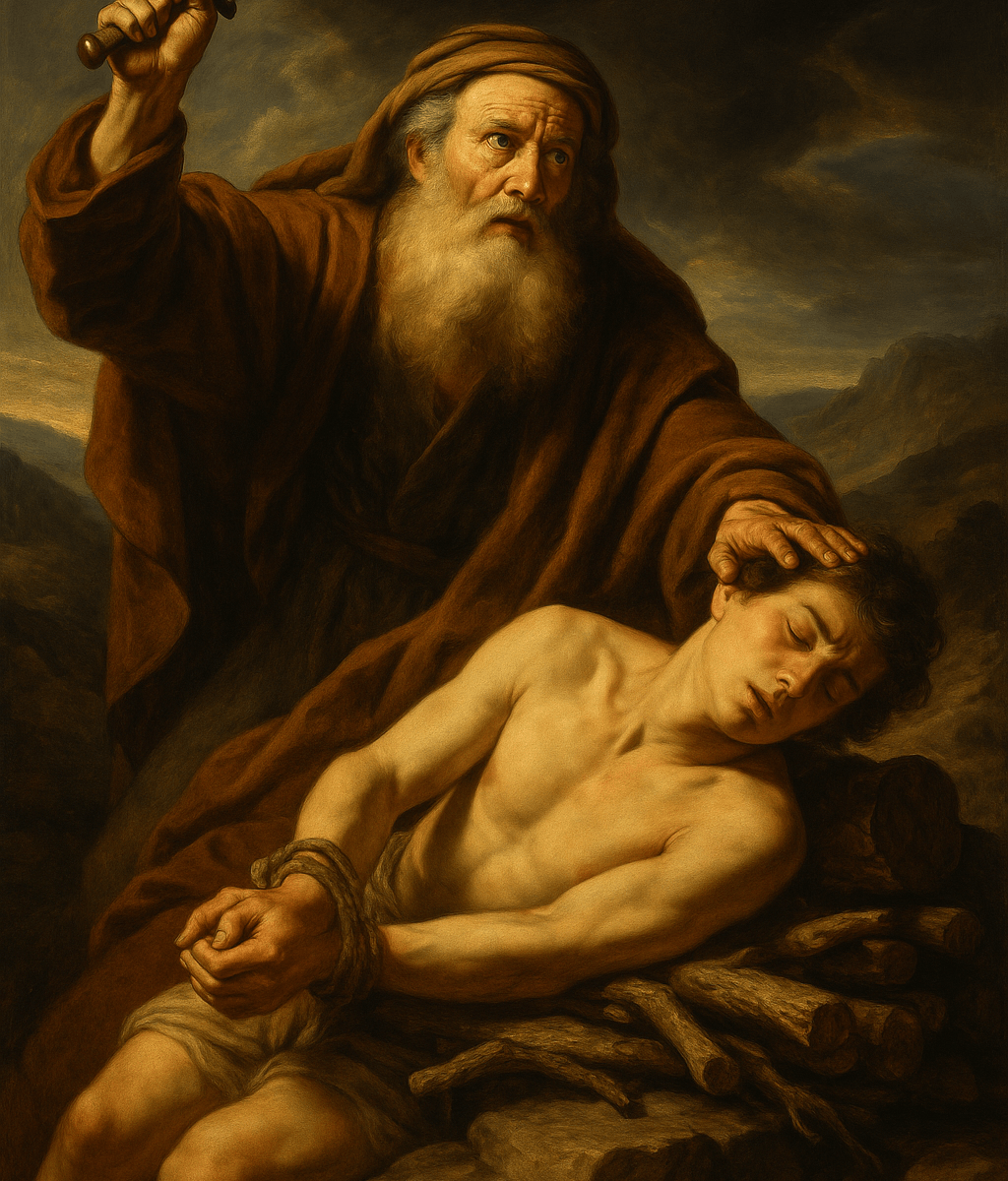
There’s a moment in Abraham’s story that stops us in our tracks—not because it’s neat and inspiring, but because it’s raw and deeply human. God asked Abraham to do the unthinkable: offer up Isaac, the son of promise, as a sacrifice on Mount Moriah. It defied every instinct of a father’s heart and shattered every cultural and moral expectation. And yet, Abraham obeyed. Not because he understood—but because he trusted.
As he and Isaac walked up that mountain together, Isaac asked,
“’Father… where is the lamb for the burnt offering?‘ And Abraham replied, ‘God himself will provide the lamb.’” – Genesis 22:8
That answer wasn’t just for Isaac—it was a declaration of faith to God. Abraham was saying, “I don’t see the way forward, but I believe You’ll make one.”
What’s easy to overlook is that Isaac was old enough to remember this moment. He wasn’t a baby—he was carrying the wood, asking questions, watching his father. And what he witnessed wasn’t just his dad’s willingness to sacrifice—it was his dad’s unwavering trust in God’s provision. That day on the mountain wasn’t just a test of Abraham’s faith. It was a training ground of trust for his son.
Fathers, your children are watching how you respond when life gets hard—when money is tight, when health is threatened, when your plans fall apart. They may not remember every lesson you teach, but they’ll never forget how you leaned into God when things didn’t make sense. When they see you seek the Lord in prayer instead of spiraling in worry, when they hear you say, “Let’s trust God together,” they’re learning that faith isn’t just something we say—it’s something we live.
This is how we pass on legacy. Not simply through instruction, but through example. Solomon says,
“Whoever fears the Lord has a secure fortress, and for their children it will be a refuge.” – Proverbs 14:26
When your life is anchored in the character of God, it becomes a shelter for your children’s faith—even when they go through their own trials.
So when you face the unknown, don’t shield your children from your process. Let them see your dependence on God. Let them walk up the mountain with you and hear your voice declare, “God will provide.” Because the moment you choose trust over control, you’re teaching them something they’ll carry for the rest of their lives: that God can be trusted—even when you can’t see the ram in the thicket yet.
5. Legacy Is Built One Surrendered Day at a Time
Legacy is one of those words we often associate with the end of life—but in truth, it’s being written right now, in the ordinary days and unseen choices of fatherhood. Abraham understood this. As his life neared its final chapter, he had fathered many sons—Isaac, Ishmael, and six more through Keturah. But when it came time to pass on the inheritance, Scripture tells us,
“Abraham gave all he had to Isaac.” – Genesis 25:5
That decision wasn’t rooted in favoritism—it was rooted in faith. Abraham remembered what God had spoken. He didn’t leave his legacy up to sentiment, tradition, or ease. He chose intentionality. He structured his family’s future around what God had promised, ensuring that Isaac—the son of the covenant—would carry the torch forward. It was a quiet but profound act of stewardship.
For fathers today, the call is no different. You are building legacy—not with grand gestures or public accolades, but through daily choices to prioritize what matters most. It’s found in the way you treat your spouse, the way you listen to your children, the way you respond when you’re tired, interrupted, or tested. Legacy is etched into the rhythm of bedtime prayers, gentle correction, weekend breakfasts, and unexpected “I’m proud of you” moments.
Psalm 78 reminds us of the generational weight we carry:
“We will not hide them from their children, but tell to the coming generation the glorious deeds of the Lord… so that they should set their hope in God.”
– Psalm 78:4, 7
What you live today becomes the lens through which your children learn who God is.
You’re not just managing behavior—you’re shaping souls. You’re not raising kids for culture’s applause—you’re preparing them for kingdom purpose. And while the world celebrates instant success, God honors steady surrender.
So start now. Write the note. Speak the blessing. Make the time. Ask God not just for patience in parenting, but for vision—vision to see who your child is becoming, and how you can help point them to the One who holds their future. Because legacy isn’t a someday idea—it’s a today decision, lived out one surrendered day at a time.
Final Thought: Faithful Fathers Leave Eternal Footprints
Abraham didn’t get it all right. He doubted. He feared. He stumbled more than once. But God never defined him by his failures—He remembered him for his faith. As Paul tells us,
“Yet he did not waver through unbelief regarding the promise of God… being fully persuaded that God had power to do what he had promised.” – Romans 4:20–21
That’s what God honors. Not perfection. Not performance. But belief. Trust. Obedience in the midst of uncertainty.
And that’s the heart of fatherhood.
You’re not called to be the hero of your family’s story—you’re called to point your children to the One who is. The Father who is steady when you’re shaken. Faithful when you fall short. Present when you feel alone. The One who never fails, never leaves, and never breaks His promises. Every moment you lead with humility, love with intention, and walk by faith, you’re laying down eternal footprints your children can follow.
So if you’re feeling discouraged today—if the weight of fatherhood feels too heavy, or the road ahead feels unclear—take heart. God doesn’t ask you to carry it alone. He walks with you. He strengthens you. And He takes every imperfect offering of love, every unseen act of obedience, and uses it to build something far greater than you can imagine.
Keep walking, Dad. Even when it’s hard. Keep trusting, even when the outcome isn’t visible. Keep showing up, even when you’re not sure it’s making a difference. Because the legacy you’re shaping isn’t measured by applause or ease—it’s being built in the quiet, faithful steps of everyday surrender. And one day, your children won’t just remember what you taught them. They’ll remember the kind of man you were when no one else was looking. And through your life, they just might learn to trust the Father who never lets go.
This Father’s Day, may you be reminded: you are seen, you are called, and you are being used by God—one surrendered step at a time.

 Pastor Luke
 Eternal Viewpoint
Recent Comments